 Chopsticks Guide
Before Buying Antique Japanese Chopsticks: Material, Condition, and Provenance
Quick Answer: Antique Japanese chopsticks should be assessed as objects with an uncertain history, not dated from color, decoration, or a wooden box alone. Record their materials and construction, inspect the finish and structure, preserve ownership evidence, and keep a damaged or unidentified pair out of food use until a qualified specialist has evaluated it.
Start with the object, not the seller's date
The word antique is often used loosely in listings. A date supplied by a seller may be a useful lead, but it is not the same as a dated invoice, an old photograph, a maker record, or a documented chain of ownership. Begin with what can actually be observed.
Record the length, cross-section, taper, tip shape, decoration, box, and any visible join or repair. Photograph both sides, the tips, the top ends, and the pair inside and outside its container. Do not remove a label, ribbon, paper insert, or box lining merely because it looks secondary; it may be part of the object's history.
Japanese chopsticks can be made from wood, bamboo, metal, synthetic materials, or combinations that include lacquer and decorative inlay. The Metropolitan Museum of Art's care guide notes that Asian lacquer, commonly called urushi in Japanese, was applied to many everyday objects, including chopsticks. That supports lacquer as a material category, but it does not authenticate a particular pair or establish its date.
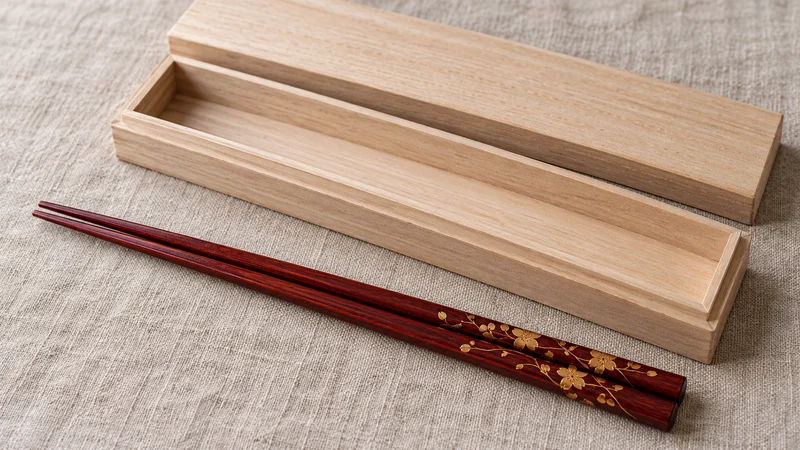
Material and condition facts to record first
- Age claim
- A seller date is a lead, not proof
- Material
- Wood, lacquer, metal, shell, or another inlay should be identified separately
- Condition
- Check cracks, lifting lacquer, repairs, and tip wear
- Provenance
- Keep ownership history, invoices, box details, and photographs together
- Food use
- Do not assume an old or damaged finish is food-safe
A useful first record separates five questions: what the age claim is, what materials appear to be present, what damage is visible, what ownership history exists, and whether the pair is intended for display or food use.
Quick Reference
| Check | What to record | What it cannot prove alone |
|---|---|---|
| Box | Wood type, lining, closures, labels, fit | That the pair was made with the box |
| Decoration | Motif, color, inlay, gilding, tool marks | A maker, exact period, or region |
| Surface | Gloss, wear, lifting, cracks, repairs | Whether the coating is original or food-safe |
| Construction | Length, taper, joins, core material | Age without comparative evidence |
| Ownership history | Names, dates, invoices, photographs | Missing portions of the chain |
Keep descriptions literal. “Dark red lacquer with gold floral decoration” is more useful than “Edo-period ceremonial pair” unless a reliable source supports the period and function. Measurements and close photographs also allow a conservator, curator, or specialist dealer to discuss the same evidence without relying on memory.
Inspect the finish before cleaning or using the pair
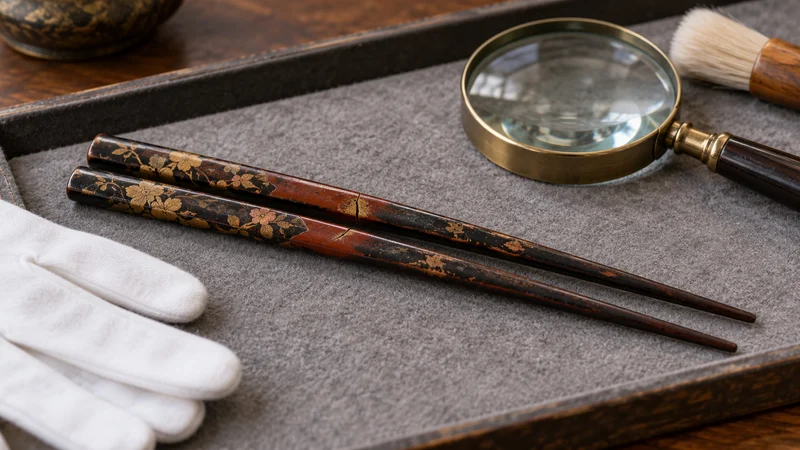
Use bright, indirect light and support the pair on a padded surface. Look for cracks across the core, separation at joins, lifting or flaking lacquer, rough repairs, sticky coating, corrosion around metal fittings, and heavy wear at the eating tips. Compare both sticks because uneven wear may reveal replacement or different use histories.
The Canadian Conservation Institute's guidance on finished objects says degraded Asian lacquer and loose finishes should be referred to an experienced conservator. Its handling guidance also emphasizes supporting fragile objects and avoiding pressure on vulnerable areas.
Those sources are conservation boundaries, not a home cleaning formula. Do not soak, scrub, polish, oil, or solvent-clean an uncertain old finish. Water may enter cracks, abrasion can remove decoration, and a modern coating applied over an old surface may obscure evidence. If the pair is dusty, isolate it from food and seek object-specific advice rather than experimenting on the surface.
Build a provenance file that another person can check
The Smithsonian defines provenance as the ownership history of an object from its creation to the present and notes that such histories are often incomplete. For a household pair, a practical provenance file can still preserve what is known without pretending to fill every gap.
Keep the following together:
- photographs of the pair, box, labels, and any damage;
- purchase receipt, auction listing, gift note, or estate inventory;
- names and dates connected with prior owners;
- the place where the pair was bought or inherited;
- copies of specialist opinions, with the evidence each opinion used;
- a log of repairs, cleaning, or storage changes.
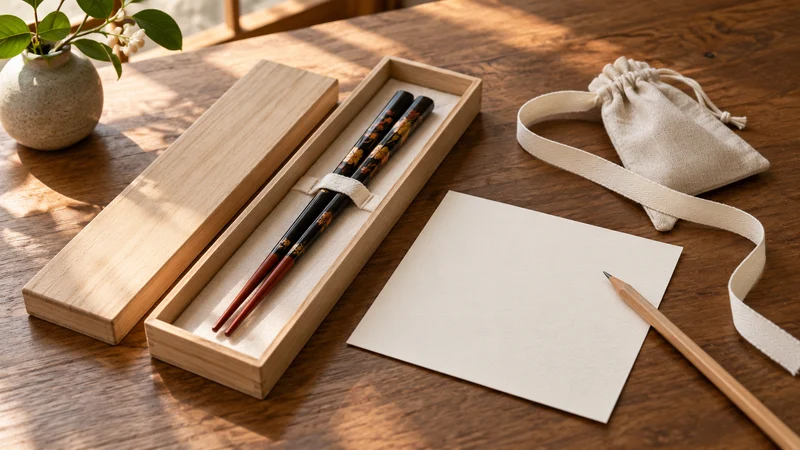
Write uncertainty plainly. “Reportedly acquired in Kyoto before 1960; receipt not retained” is more honest and useful than converting family memory into a verified date. A box that fits neatly may be original, later, or simply convenient. Record it as an associated box unless evidence connects the two.
Choose storage or food use as separate decisions
An attractive old pair can be meaningful without returning to the dining table. If the finish is cracked, lifting, sticky, unidentified, or previously repaired, use it for display or study rather than food. The absence of visible damage is not proof that every coating or repair material is suitable for contact with food.
For storage, keep the pair supported, dry, and away from strong light, rapid humidity changes, and crowded drawers where hard objects can scrape the surface. Do not bind the sticks tightly with elastic that can mark the finish. Retain the box when it is clean and stable, but add inert padding if the pair moves enough to strike the sides.
If the goal is regular dining rather than collecting, a documented modern pair is easier to evaluate and care for. Compare modern Japanese wooden chopsticks by grip, finish, washing instructions, and intended use.
Questions about antique Japanese chopsticks
How can I tell whether Japanese chopsticks are antique?
You usually cannot establish age from appearance alone. Record construction, condition, box details, ownership history, receipts, and old photographs, then seek a qualified specialist when authentication matters.
Does a wooden presentation box prove the age?
No. The box may be original, later, or unrelated. Treat it as associated evidence until records or a specialist assessment connect it to the pair.
Should I wash old lacquered chopsticks?
Do not automatically soak or scrub an uncertain old finish. Flaking, cracked, sticky, or repaired lacquer needs object-specific conservation advice, not routine dishwashing.
Can antique chopsticks be used for eating?
Do not assume so. If the material, coating, repair history, or structural condition is uncertain, keep the pair out of food use until a qualified professional has assessed it.
What should a provenance file contain?
Include clear photographs, dimensions, receipts or listings, ownership names and dates, box and label details, specialist opinions, and a record of any cleaning or repair.
The safest conclusion is often modest: describe what is visible, preserve what is known, and keep authentication, conservation, and food use as separate decisions.