 Chopsticks Guide
Japanese Wooden Chopsticks: Shape, Finish, Care, and Selection
A Japanese label describes cultural and design context, not one uniform material. Inspect the actual pair before deciding how it should be used or washed.
Quick Answer: Start with the product's stated material and purpose. Then check the tip profile, cross-section, finish, length, and care instructions. A lacquered reusable pair, unfinished wood pair, bamboo pair, and long cooking pair can all look Japanese, but they do not share one cleaning rule or one task. Choose the pair whose construction and maker directions fit your meal and routine.
What the label does and does not tell you
- Common profile
- Eating pairs often use relatively fine tips, but shapes vary
- Reusable finish
- Wood may be lacquered or sold with another stated coating
- Purpose
- Eating, serving, cooking, ramen, training, and travel pairs differ
- Care
- The maker's instructions outrank a generic material rule
- Inspection
- Check tips, finish, straightness, and surface damage before use
- Boundary
- Country style alone does not prove wood species, coating, or safety
Begin with construction, not the word Japanese
Two pairs sold as Japanese wooden chopsticks can require different decisions. One may be a plain wood eating pair with a matte surface; another may be wooden chopsticks sealed under multiple lacquer layers. A third may use bamboo, composite material, or a modern coating while borrowing a familiar Japanese silhouette. The country-style label is useful context, but it is not a complete material specification.
Read the listing or packaging for four separate facts: the base material, the surface finish, the intended task, and the care method. If one of those facts is missing, treat it as unknown. A glossy surface does not by itself identify traditional lacquer, and visible grain does not prove that the wood is unfinished.
This distinction matters because the finish is the food-contact surface you touch and clean. It also matters when comparing price: decoration, craft process, packaging, and branding can affect cost without changing the basic eating task.
Read the tip and shaft as working features
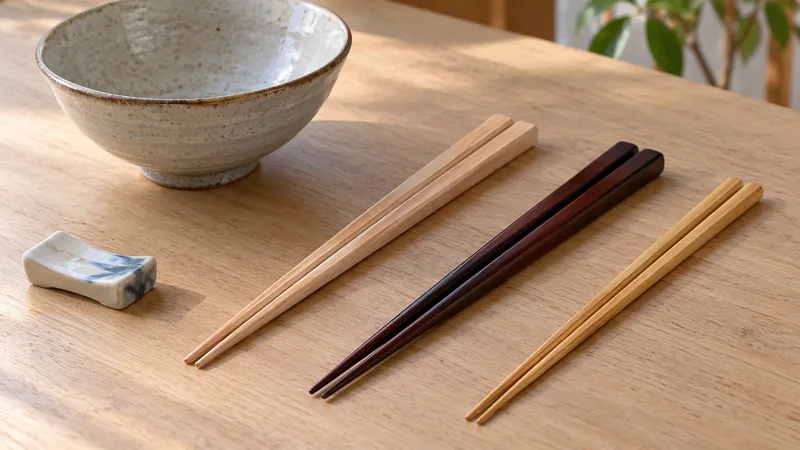
Web Japan describes Japanese chopsticks as commonly having narrower tips than chopsticks from other countries. Fine tips can support controlled movements such as picking up small pieces, separating cooked fish, or handling noodles. That is a tendency, not a rule for every product: ramen chopsticks may add grooves, children's pairs may be shorter, and specialty utensils may change thickness or material for a specific job.
Look at the full shaft rather than the point alone. A square or faceted handle may resist rolling on the table. A round handle can feel smooth but may rotate more easily in the fingers. The transition from handle to tip should be even on both sticks, and the tips should meet without one crossing above the other.
Length should match both the user and the task. An eating pair that feels balanced at the table is not automatically a cooking tool. Web Japan describes saibashi cooking chopsticks as thicker and longer than eating chopsticks, often over 30 centimeters, which helps keep hands farther from heat. Use a product sold for cooking when heat exposure is part of the job.
Lacquer changes the surface, not every care rule
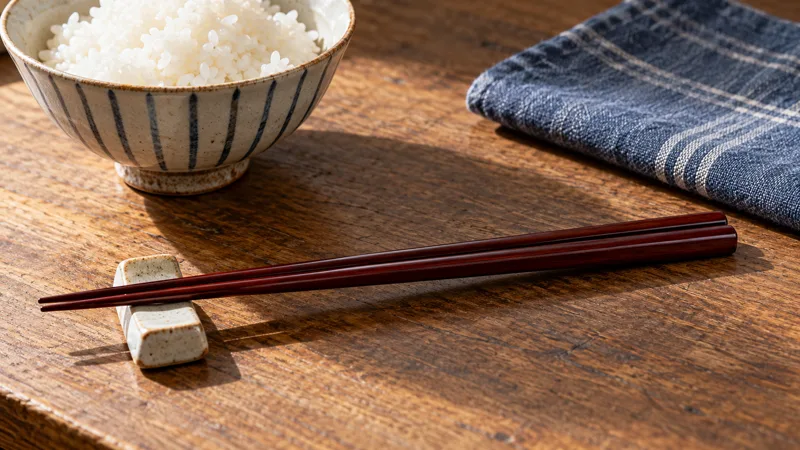
Traditional lacquered eating chopsticks are often called nuribashi. Web Japan explains that layers of strong, water-resistant lacquer can allow wooden chopsticks to be washed and reused. Another Web Japan feature notes that lacquer on wooden utensils adds luster and durability. Those descriptions explain why lacquer is used; they do not make every coated pair dishwasher-safe or damage-proof.
Inspect a lacquered pair under ordinary light. The surface should be continuous, without lifting edges, deep chips, bubbles that have opened, or exposed splinters. Decorative flecks or mother-of-pearl can be intentional, while a ragged edge around a chip is damage. When the product description names a synthetic coating rather than lacquer, follow that material statement instead of relabeling it.
For an unknown reusable pair, the conservative routine is prompt hand washing with mild soap, a soft sponge, and short water contact, followed by open-air drying. Do not soak the pair, scrub it with abrasive pads, or place it in a dishwasher unless the maker explicitly permits that treatment. As one manufacturer-specific example, Marunao tells owners of its chopsticks to wipe moisture promptly and avoid dishwashers and dryers; apply that guidance only to products covered by Marunao's instructions, not to every wooden pair.
Match the pair to the meal and the user
A fine-tipped eating pair suits many table tasks, but comfort depends on grip, hand size, texture, and the foods being served. A beginner may prefer a little more surface texture and a stable faceted handle. Someone eating slippery noodles may value tip grooves. A shorter pair can suit a smaller hand, while a decorative souvenir may be better judged by its actual food-use labeling before daily use.
Do not confuse eating chopsticks with serving chopsticks. Shared meals may use a separate pair for moving food from common dishes. Cooking chopsticks need their own heat and length considerations. The site's regional chopstick comparison explains broad design differences, while the length guide focuses on fit rather than origin.
For online buying, seek close photos of the tips and finish, an exact length, the named base material, the coating description, and written care instructions. If the listing provides only decorative language, it has not answered the practical questions needed for comparison.
Wash, dry, and store the pair as one system
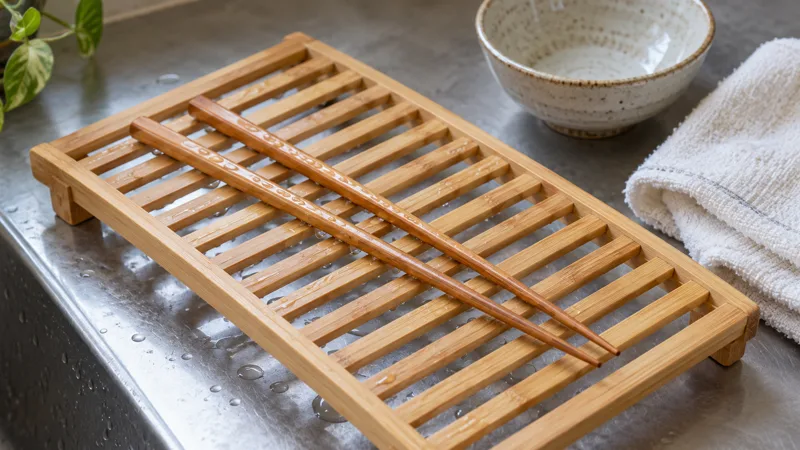
Cleaning is not complete when visible food is gone. Rinse and wash soon after the meal so residue does not dry around grooves or textured tips. Use the care method on the product label. Keep water exposure brief for wood when no stronger claim is provided, then dry the surface and place the pair where air can circulate.
Do not bundle damp chopsticks tightly in a closed case. A travel case is useful after the pair is dry, but it can trap moisture immediately after washing. Store the two sticks together without forcing them against sharp metal utensils that could scratch a finish.
The surface deserves a quick check each time you clean it. Look for splinters, deep cracks, peeling finish, persistent odor, warped shafts, or tips that no longer meet. The wooden chopstick cleaning guide covers the washing sequence in more detail, and the storage guide explains airflow and holder placement.
Know when a finish has reached its limit
Normal use can soften gloss or create small color differences, especially on natural materials. Replacement is about damage that affects cleaning, comfort, or the food-contact surface. Retire a pair with a splinter, deep crack, loose coating, sharp chipped edge, persistent odor, or deformation that prevents the tips from meeting.
Do not sand a coated pair unless the maker specifically provides a repair method; sanding can remove an intended food-contact finish and create an uneven surface. Do not cover damage with household paint, glue, oil, or nail polish. Those products are not automatically suitable for repeated food contact.
If you cannot identify the pair's material or coating, replacement is often more practical than experimenting with aggressive cleaning or refinishing. Keep the packaging or a photo of the care label when buying a reusable pair, especially if it will be used daily.
A five-part inspection before choosing a pair
| Check | What to look for | Why it matters |
|---|---|---|
| Material | Named wood, bamboo, composite, or other base | Prevents guessing from color or grain |
| Finish | Lacquer, another coating, or explicitly unfinished surface | Guides cleaning and damage checks |
| Shape | Tip profile, shaft cross-section, straightness, matching pair | Affects control, comfort, and rolling |
| Purpose | Eating, serving, cooking, training, ramen, or travel | Keeps a table utensil out of a heat task |
| Care | Hand-wash, dishwasher permission, drying and storage notes | Provides the maker-specific routine |
Questions about Japanese wooden chopsticks
Are all Japanese wooden chopsticks lacquered?
No. Japanese-style pairs are sold with many constructions and finishes. Check the product description for the base material, coating, food-contact use, and care directions instead of assuming every glossy pair uses traditional lacquer.
Why do many Japanese chopsticks have fine tips?
Web Japan notes that Japanese chopsticks commonly have narrower tips, which can help with controlled tasks such as picking up small pieces or separating food. Tip shape still varies by pair and intended use.
Can lacquered wooden chopsticks go in a dishwasher?
Follow the maker's care directions. If the pair is not explicitly labeled dishwasher-safe, hand-wash it promptly, avoid soaking, and dry it with air circulation rather than assuming every coating tolerates repeated heat and detergent.
How can I tell whether a pair is for eating or cooking?
Check the stated purpose and length. Web Japan describes saibashi cooking chopsticks as thicker and longer than eating chopsticks, often over 30 centimeters. Do not identify an unknown pair by appearance alone.
When should wooden chopsticks be replaced?
Stop using a pair if the surface has deep cracks, splinters, a loose or peeling finish, persistent odor, or damage that cannot be cleaned. Minor color variation in natural wood is not by itself proof of damage.
Sources and next reading
Web Japan, a project of Japan's Ministry of Foreign Affairs, describes Japanese chopstick forms, uses, lacquered nuribashi, and long cooking chopsticks. Its Niponica overview of chopsticks shows the range of lacquered, decorated, high-quality wood, purpose-specific, and children's pairs. A separate Web Japan feature on lacquerware explains lacquer's use on wooden utensils.
Continue with the wood comparison guide, replacement guide, or bamboo versus wood buying guide.