 Chopsticks Guide
Fork Chopsticks: Compare Hybrid Designs Before You Buy
Start with the mechanism, then compare reach, tip alignment, food fit, joints, and cleaning access.
Quick Answer: Fork chopsticks are not one standard utensil. Some reverse between a fork end and flexible chopstick arms, some stay joined like small tongs, and some separate into two chopsticks. Compare the actual layout, usable length, grip, joints, and cleaning instructions before treating one as a substitute for either a fork or an ordinary pair of chopsticks.
Fork chopsticks at a glance
- Category
- A loose name for several fork-and-chopstick hybrid mechanisms
- Layouts
- Reversible one-piece, joined tong-like, or separable combination designs
- Working length
- Measure the usable stick section below any fork head, hinge, or coupling
- Technique
- A joined squeeze action does not reproduce independent chopstick movement
- Cleaning
- Hinges, fork tines, seams, and detachable recesses need direct access
- Evidence limit
- Patents document configurations, not current product quality or performance
Identify the hybrid before judging it
A search for fork chopsticks can lead to several different objects. One product may have fork tines at one end and two flexible chopstick arms at the other. Another may begin as a joined fork-like utensil, then split into two sticks. A third may simply be a travel set that stores a fork beside a normal pair of chopsticks. These designs solve different problems.
The first question is mechanical: which parts touch the food, which end goes in the hand, and does the utensil remain joined? A novelty name is not enough. Look at the product from both sides and find the point where the arms flex, separate, lock, or transition into fork tines.
Patent documents show why the category is easy to confuse. US5056173A describes a one-piece utensil with a fork portion and flexible chopstick arms used in opposite orientations. US7878563B2 describes another arrangement with chopstick members, a base, and a fork end, including versions that separate or reconnect. Those records document design concepts; they do not prove that every product sold under a similar name works well.
Compare three fork-chopstick layouts
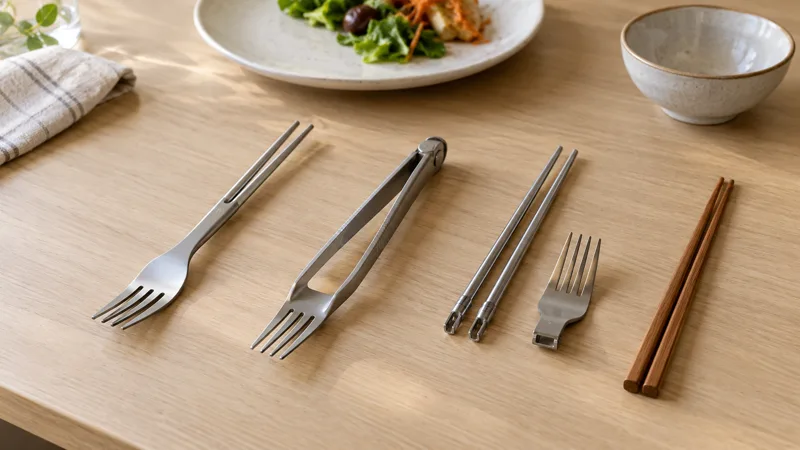
Reversible one-piece design. The fork sits at one end while flexible arms extend from the other. Turning the tool changes which end meets the food. No loose parts need to be stored, but the unused end becomes the handle, so hand placement and hygiene need attention.
Joined or hinged fork-tong design. Two arms remain connected and close together with a squeeze. The tips may end in fork-like tines or the base may form a fork profile. This can feel closer to small tongs than to two independent chopsticks. It may help with pinching, but it does not reproduce the standard technique in which the lower chopstick stays still and the upper one moves.
Separable combination. A base or coupling holds two members together for fork mode, then releases them for chopstick mode. Separation provides more familiar chopstick movement, but the joint adds parts to inspect and clean. A detachable mechanism can also change balance or reduce usable stick length.
Match each mode to the food in front of you
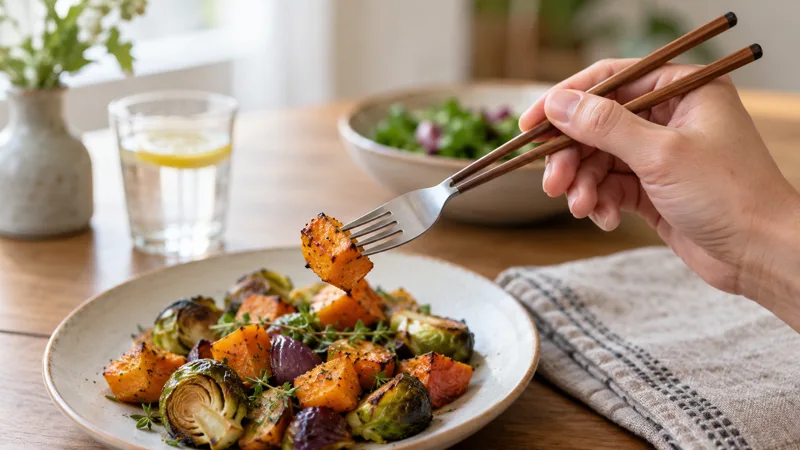
Fork mode is useful for firm pieces that can be speared without crumbling: roasted vegetables, pasta pieces, fruit chunks, or a compact bite of meat. It is less useful for broth, very soft tofu, or loose grains. A small fork head may also carry less food than a standard dinner fork.
A tong-like mode can grip dumplings, sliced vegetables, sushi, or noodles when the tips meet evenly. If the arms are short or spring pressure is high, delicate foods may be crushed. If the tips are broad and smooth, small slippery foods may escape even though the utensil looks easy to use.
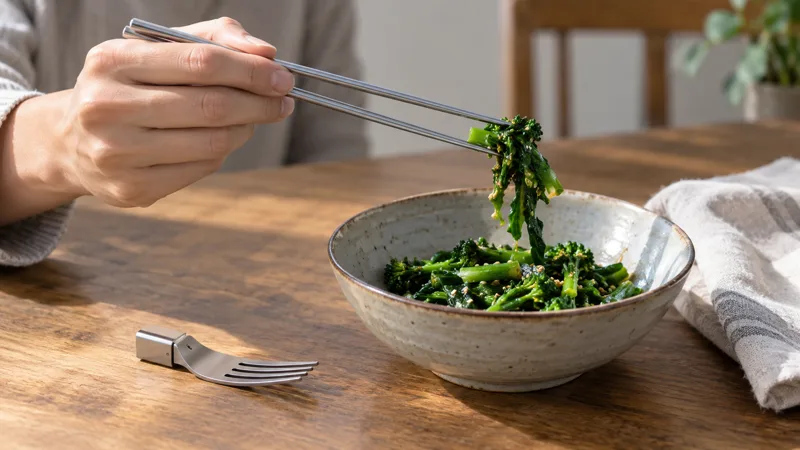
Separated chopstick mode is the closest test of whether the tool works as chopsticks. Check whether both sticks have enough length below the joint area, whether the tips align, and whether a fork attachment interferes with finger placement. Loose rice still may be easier with a spoon; a hybrid does not need to solve every food task to be useful.
Check grip, reach, and the transition between modes
Hold the hybrid before relying on its fork function. In fork mode, the handle should not twist when pressure reaches the tines. In chopstick mode, the tips should meet without the arms crossing. A bulky transition block can push the grip too far from the food, reducing control.
Compare usable length rather than total length. Fork tines, hinges, and couplings can make a product look long while leaving a short working section. For an adult hand, the key question is whether the fingers can rest where the design expects without touching a food-contact end or blocking the flex point.
Switch modes slowly the first time. If the product snaps apart, identify the intended release point instead of bending random sections. If it rotates or folds, check that the lock is fully engaged. Stop using a mechanism that cracks, sticks, or releases unexpectedly.
Inspect joints and surfaces before reuse
Hybrid designs create more places for residue to collect. Examine grooves around a hinge, the underside of fork tines, coupling slots, seams, and textured grip areas. If parts detach, wash and dry them according to the maker's instructions before reassembly. Do not assume every material or mechanism is dishwasher safe.
The FDA Food Code describes food-contact utensils in terms that include durability, smoothness, and cleanability. It is a model code for retail and food service, not a certification for a product on this page, but the criteria provide a practical inspection lens. A reusable hybrid should not have cracked joints, rough damaged surfaces, deep scoring, trapped residue, or distorted tips.
For a reversible design, decide where clean hands will hold the utensil after one end has touched food. For a separable design, confirm that every recess can be reached during washing and dried before storage. Convenience disappears quickly if switching modes transfers sauce to the hand or leaves a joint damp.
Decide whether the hybrid serves your real goal
Choose fork chopsticks when one compact tool genuinely helps with a mixed meal or a travel kit. A well-matched hybrid can reduce utensil switching and offer a fork fallback without carrying a separate full-size fork. That is a convenience decision, not proof that the tool is better than ordinary cutlery.
If the goal is to learn standard chopstick technique, compare the hybrid with a normal pair or a simple training aid. A permanently joined tong action may help someone pick up food, but it teaches a different movement. The site's best chopsticks for beginners guide explains how grip, tip texture, and length affect learning without adding fork hardware.
If the goal is versatility, compare a hybrid with a separate travel set. Separate utensils take more pieces, yet each tool can keep its familiar balance, reach, and cleaning method. The better choice is the one that fits the meal and can be cleaned reliably, not the one with the longest feature list.
Compare a hybrid before buying
| Check | What to look for | Why it matters |
|---|---|---|
| Mechanism | Reversible, hinged, separable, or simply stored together | Determines how the tool is held and switched |
| Working length | Usable stick length below any joint or fork head | Short reach can reduce control |
| Tip alignment | Tips meet evenly without crossing | Affects gripping in chopstick mode |
| Fork head | Tines are smooth, aligned, and comfortable to angle | Affects spearing and mouth feel |
| Joint access | Grooves and seams are reachable during washing | Reduces trapped residue |
| Learning goal | Convenience, tong control, or standard chopstick skill | Different designs teach different motions |
Questions about fork chopsticks
What are fork chopsticks?
Fork chopsticks are hybrid eating utensils that combine a fork function with a chopstick or tong-like function. The exact mechanism varies, so identify the design before deciding how it should be held, cleaned, or used.
Are fork chopsticks easier than regular chopsticks?
They may feel easier when you switch to fork mode, but that does not necessarily teach independent chopstick control. A hinged hybrid can also feel different from two separate chopsticks.
Can fork chopsticks separate into two sticks?
Some designs separate or detach into two sticks; others remain one flexible piece, and some place fork tines at the opposite end. Check the actual mechanism instead of assuming all hybrids work alike.
Can you use fork chopsticks with rice?
Fork mode can spear compact pieces, while chopstick or tong mode may pick up clumps. Loose rice is usually easier with a spoon or a bowl-appropriate method, so a hybrid does not solve every food task.
How should fork chopsticks be cleaned?
Follow the exact product instructions. Pay particular attention to joints, grooves, seams, and detachable parts, because a design that traps food residue is harder to clean reliably.
Sources and related guides
The visible design distinctions use US5056173A and US7878563B2 as examples of different combination-utensil configurations. The FDA Food Code 2026 supplies general surface and cleanability criteria, not a product endorsement.
For related comparisons, see chopstick spoon sets, cutlery sets with chopsticks, the chopstick length guide, and the care and cleaning guide.