 Chopsticks Guide
Metal Cooking Chopsticks: Which Tips Fit Your Pan?
Quick Answer: Metal cooking chopsticks are useful when you need to turn small pieces in a pan, separate noodles, or move food without bringing your hand directly over the cooking surface. Start with the part that touches the pan, not the material in the product name. A bare steel tip, a silicone-covered tip and a steel shaft with a plastic handle are different constructions. For nonstick cookware, follow the pan maker's utensil instructions and avoid bare metal if the instructions call for softer utensils.
Start with the surface you cook on
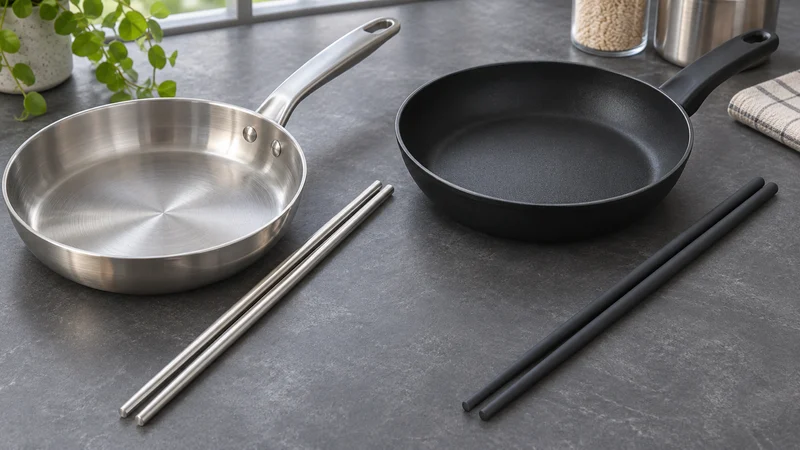
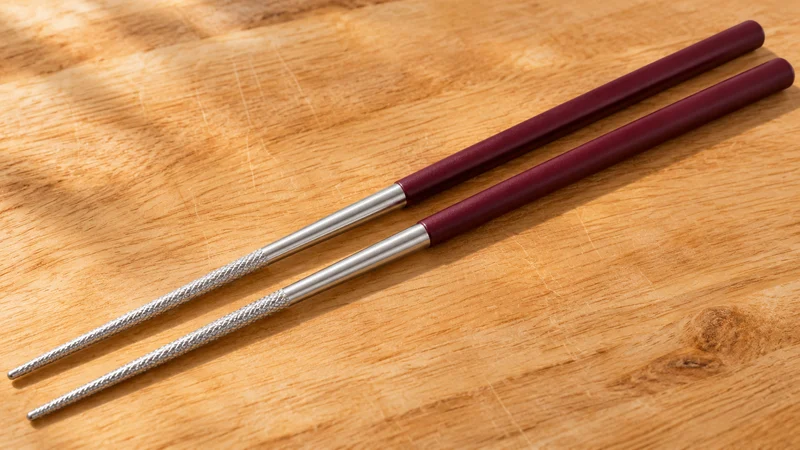
For a pan that permits metal utensils, a bare, textured stainless steel tip can be useful for turning individual pieces. Texture matters because a wet piece of food can rotate between smooth tips. Try closing the ends on a piece of firm food before using the chopsticks over a hot pan. Both tips should meet without forcing your wrist to twist. If one slides past the other or the tips feel too narrow for what you want to lift, use tongs instead.
For a pan that does not permit metal utensils, look for a soft contact surface that stays covered where the tool can touch the pan. That includes the sides of the tips, not just their ends. An exposed steel shaft can still touch the rim when you reach into a deep pan. Retire a coated pair from that job if its coating tears or the core becomes exposed. A wooden or bamboo cooking pair may be a simpler choice when you do not need metal tips.
Quick Facts
- Compare pan contact
- Bare steel and coated tips are different contact surfaces. Follow the cookware maker.
- Handle heat limit
- A handle specification does not rate the whole tool for immersion.
- Reach and grip
- Check whether both tips meet naturally over a cold pan.
- Cleaning
- Follow the instructions for the exact model and its materials.
Read the tip, shaft and handle specifications separately
KAI's SELECT100 DH3104 product page specifies 33 cm long cooking chopsticks with blasted stainless steel tips and a polyacetal handle. It gives 140°C for the handle, not for the steel tips or for immersion of the whole utensil. KAI lists this model as dishwasher safe. Those are useful model-specific facts, not a general temperature or care rule for metal cooking chopsticks.
The IKEA Japan LUNGROT page describes a 30 cm pair made with steel and silicone rubber, with a silicone-coated contact surface. IKEA lists 220°C for that product and says it is dishwasher safe. These two examples illustrate why a store filter such as “metal” is not enough. One uses steel at the point of contact, while the other uses steel in a tool with coated tips. A rating for one product does not carry over to the other.
Quick Reference
| Check | What to look for |
|---|---|
| Pan contact | Bare steel or intact soft coating |
| Handle | Material and stated heat limit |
| Reach | Enough space without losing control |
| Cleaning | Instructions for the exact pair |
Choose reach you can control
A 33 cm pair reaches farther into a pan than a 30 cm pair held in the same place. That extra reach isn't automatically better for small tasks such as arranging garnishes on a plate. When comparing the two lengths, check how much stick extends beyond your grip and whether you can still move the tips precisely. Choose for the task rather than treating one length as a safety guarantee.
Before you cook, practice opening and closing the pair over a cold pan. Check whether the tips meet naturally when your hand is high enough to clear the rim. If you're lifting something large, heavy or likely to slip, use tongs or a slotted tool instead. Don't rest a metal shaft against a hot rim or leave the chopsticks sitting in hot oil. A longer handle gives distance; it doesn't stop heat from traveling through the utensil.
The site's metal chopstick material guide explains why grip and heat transfer differ from wood at the table. If two loose sticks are awkward at the stove, compare them with the chopstick cooking tongs guide: a joined tool keeps the ends aligned, though it handles differently from a loose pair.
Questions about metal cooking chopsticks
Can I use ordinary metal eating chopsticks for frying?
A dining pair is not necessarily designed for a hot pan. Check that its maker intends it for cooking and that you can keep your grip clear of the heat and steam. If you can't verify those points, use a cooking utensil with a stated intended use.
Are silicone-tipped metal chopsticks the same as bare steel?
No. When the covering is intact, silicone is the surface that touches food and cookware. The steel may provide stiffness underneath. Check the exact product's temperature limit and your pan maker's instructions.
Are all stainless steel cooking chopsticks dishwasher safe?
No single care rule applies to every design. A pair can also contain a polymer handle, coating or joints. Use the manufacturer's care instructions for the entire utensil rather than inferring them from the steel part.