 Chopsticks Guide
Choosing a Chopstick Case: Fit, Cleaning, and Everyday Carry
A case that looks long enough can still pinch the tips, refuse to close over thicker handles, or leave a narrow channel you cannot clean. Start with the chopsticks you actually use, then choose the container around them.
Quick Answer: Choose a chopstick case with enough usable length and handle clearance for your pair, a closure that works without pressure on the tips, and an interior you can clean and dry. A rigid shell and a fabric sleeve solve different carrying problems. Follow the instructions for the case and chopsticks separately; the material name alone does not establish dishwasher safety.
Fit and care details worth checking
- Length fit
- Use the pair's full length and the case's usable internal length, not just the outside measurement.
- Handle clearance
- Check the thickest handle section, dividers and lid clearance.
- Cleaning risk
- Separate instructions can apply to the body, lid, liner and chopsticks.
- Carrying use case
- Choose for your actual lunch bag and return-home routine, not appearance alone.
Product measurements below are examples from named listings, not universal case sizes or our own test results.
The pair you carry sets the case size
Measure from the end of one handle to its tip. Then check whether the published case dimension is an exterior length or usable inside space. Hinges, rounded ends and inserts can occupy part of a container; an outside measurement should not be treated as a guaranteed fit.
For a concrete example, MUJI's Portable Stainless Steel Cutlery Set listing gives 17.7 cm chopsticks and a case whose longest listed dimension is 19 cm. That describes a matched set. It is not a promise that another pair of similar length, but thicker handles, will fit its inserts.
If you can inspect the case, lay the dry pair inside without forcing it. Both tips should remain clear of the closure, and the lid should close in its intended way. For online buying, ask the seller for usable interior dimensions or the exact compatible pair. Avoid adding an invented 'standard clearance' to every case design.
Rigid shell or washable sleeve?
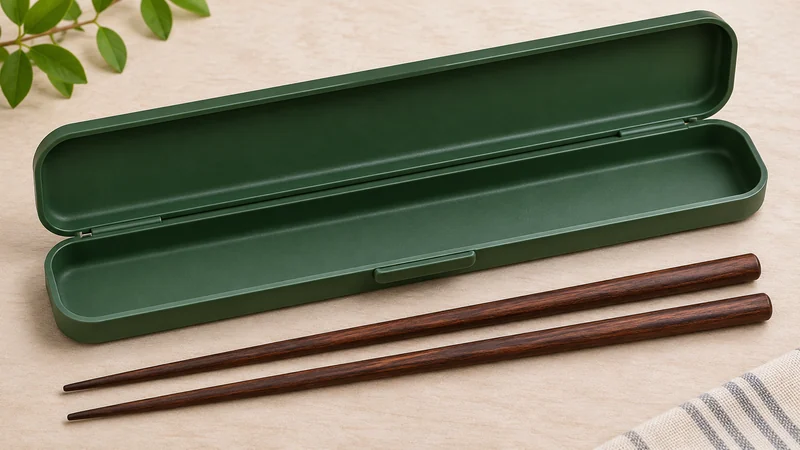
A rigid case gives the pair a defined compartment. Examine the hinge or sliding track, the tip end and any removable holder. A sleeve is more flexible around different handle shapes, but its fabric, seams and closure need their own care instructions. Neither format is automatically cleaner simply because it looks more enclosed.
Consider where it will sit. A long narrow shell may fit beside a lunch box but not across a small bag. A sleeve that rolls neatly at home may be inconvenient if the ties trail across a shared table. These are fit and handling questions to check with your belongings, not performance results from our testing.
A decorative gift box is not necessarily intended for daily food-utensil transport. Look for a stated carrying use, an accessible interior and practical instructions. Choose the pair you can comfortably eat with, rather than shortening the pair merely to suit a small box. For noodle lunches, the ramen handling guide discusses manageable portions; deciding how to carry the pair is a separate task.
Two materials can need different care
Do not extend a dishwasher symbol for one piece to every part of a set. Check the body, lid, removable insert and chopsticks. An instruction may apply only to a named component, so read the maker's actual wording rather than treating a picture of the assembled set as permission to wash everything together.
MUJI's cited set lists a different case combination, ABS for the body and AS resin for the lid, alongside steel cutlery. Its own care section states dishwasher safety and asks users to dry the products thoroughly before returning them to the case. Those instructions belong to that listed set; they are not a rule for all wooden, lacquered or plastic chopsticks.
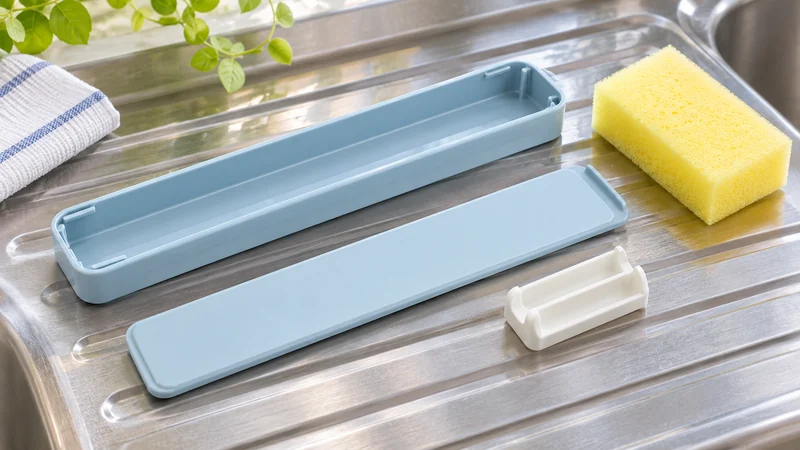
Before buying, find out whether the lid or insert can be removed for cleaning and how it should be reassembled. Do not prise apart a permanently attached hinge to make it washable. When instructions are missing or contradictory, ask the maker rather than choosing the hottest cleaning method as a substitute for guidance.
At lunch, the inside is still a storage surface
Take the pair out over a clear part of the table and put the open case where it will not obstruct other diners. A lid is not automatically designed to be a chopstick rest. Use a separate rest, or a feature the manufacturer actually identifies for that purpose, instead of balancing the tips on a narrow hinge.
The chopstick rest guide explains that separate table accessory. Its role differs from a case: one supports the pair during a meal, while the other carries it. A product photograph showing a lid beside food does not prove that the lid is approved for food contact or that it doubles as a rest.
If you carry both a personal pair and serving utensils, keep their intended uses distinct. A case organizes the objects; it does not change which utensil should be used for a shared dish. Choose a layout you can recognize and manage without spreading components across the whole table.
After lunch is the deciding test
Think through the return trip before choosing a daily case. Will you be able to follow the set's cleaning instructions at your destination, or will you need to wash it at home? Do not describe a quick wipe as equivalent to the specified cleaning procedure. Inspect the inside as well as the pair before it is packed for the next meal.
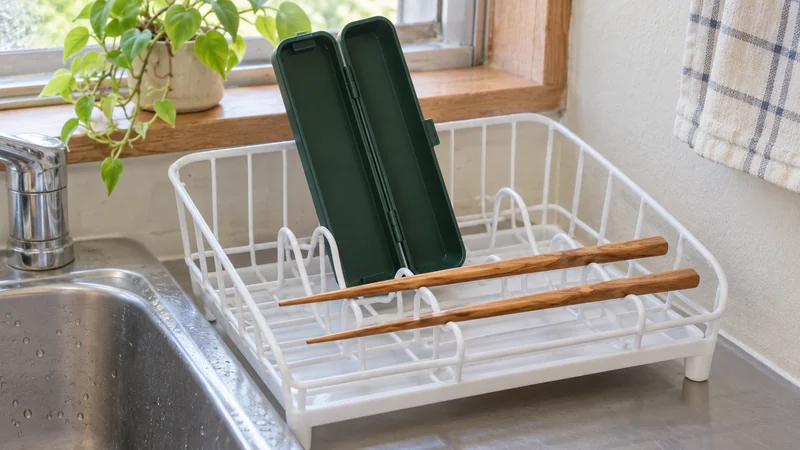
Follow the maker's drying instructions rather than sealing freshly washed pieces away immediately. MUJI's requirement to dry its set before replacing it provides a concrete example of this step. It does not prove that a fabric pouch, vented shell or antimicrobial label removes the need to clean the contents.
A useful personal check is simple: after the case has been cleaned and dried as directed, look into the tip channel, lid edge and insert. If these areas are inaccessible, or you repeatedly cannot complete the routine before your next lunch, a simpler openable design may suit you better. This is a practical selection judgment, not a claim that we have measured contamination or tested competing products.
A failed closure is a reason to stop forcing the fit
Inspect a loose latch, cracked edge or distorted lid before continuing to carry the case. Check that a removable insert has not been put back upside down and that both sticks belong to the intended set. Do not press harder on the lid to compensate for a pair that is too long.
Replace a damaged component according to the manufacturer's options, or choose another case if the pair can no longer be held as intended. A general-purpose sleeve is not automatically a repair for a sharp broken edge. Keep the decision about the actual product in front of you rather than treating any enclosed shape as an adequate substitute.
Quick Reference: five questions before you choose
| Check | Useful answer |
|---|---|
| Does the pair fit? | Full length, handle clearance and intended closure confirmed. |
| What do the dimensions mean? | Usable inside space distinguished from outside measurements. |
| Can I reach the interior? | Tip channel, track and inserts accessible as designed. |
| How is each part cleaned? | Instructions checked for case, lid and chopsticks separately. |
| Can it dry before reuse? | A realistic routine for your lunch-to-home schedule. |
No universal extra clearance, dishwasher temperature or service life is assumed.
Questions about carrying your own pair
Will any chopstick case fit my existing chopsticks?
No. Check usable length, handle thickness, dividers and the intended closure. Exterior dimensions alone do not guarantee a fit.
Does a dishwasher-safe pair mean its case is dishwasher-safe?
No. Read the instructions for the case, lid, insert and chopsticks separately. Their materials and permitted care may differ.
Can the case lid double as a chopstick rest?
Only when the product is designed and identified for that use. Otherwise, use a separate rest rather than assuming a lid is suitable.
Is a soft sleeve a substitute for cleaning the chopsticks?
No. A sleeve is a carrying format, not a cleaning process. Follow the instructions for both the sleeve and the pair.
Product examples and care instructions
Manufacturer instructions checked November 3, 2026. Illustrations are unbranded scenes, not verified MUJI product samples. No product testing or affiliate ranking is claimed.