 Chopsticks Guide
How to Use Chopsticks with Ramen: Small Bites and Spoon Support
A bundle of noodles behaves differently from a solid piece of food: it can slip, trail into the soup, and pull more strands along with it. Start with less than you think you need. The aim is a comfortable mouthful, not a high lift for a photograph.
Quick Answer: To use chopsticks with ramen, steady the lower stick, move the upper stick, and close the aligned tips around a small group of noodles. Lift just enough to separate that portion from the bowl. If it is awkward, lower it and select fewer strands, or let a soup spoon support the portion. Do not force a large or very hot mouthful.
Quick Facts for noodle handling
- Grip method
- A steady lower stick and moving upper stick
- First portion
- A few strands, not a tightly twisted ball
- Spoon role
- Optional support for a small portion or broth
- Eating habit
- Slurping noodles is accepted in Japanese dining; it is not a grip requirement
- If control is lost
- Lower the noodles into the bowl and select less
The grip and noodle-etiquette points are supported by the Japan National Tourism Organization. The practice sequence below is practical guidance, not a claim of a universally required dining ritual.
Align the tips before adding the noodles
The Japan National Tourism Organization's food-etiquette guide describes resting the lower chopstick near the base of the thumb and ring finger, with the upper one held like a pencil. Only the upper stick moves to pick up food. That gives you two tips that meet rather than crossing past each other.
Try opening and closing the tips above the empty edge of a plate first. If they cross, reset the sticks in your hand before reaching into the bowl. Squeezing harder while the tips are misaligned usually leaves the same problem in place: the space between the tips is still not where you expect it to be.
You do not need a special ramen grip. The guide to grip and utensil differences discusses the same steady-lower-stick principle in a different meal setting. Its Korean table customs are separate from the Japanese noodle context here.
Small-portion practice: lift, then adjust
Place the eating tips around a few noodle strands close to the surface, close them gently, and lift a short distance. Let the remaining length hang toward the bowl. You are separating a manageable portion, not trying to clear every strand from the broth at once.
If a large tangle comes up, lower it back into the bowl and pick again. There is no benefit to committing to an oversized mouthful simply because you have already lifted it. Likewise, a dramatic high lift is not a target for beginner practice: it leaves more hanging length to manage and can bring neighboring strands along.
Keep the bowl on a stable surface while you learn. Pause if the food is too hot. An illustrative photograph can show the utensils and noodles, but cannot establish a safe eating temperature or demonstrate what feels comfortable in your hand.
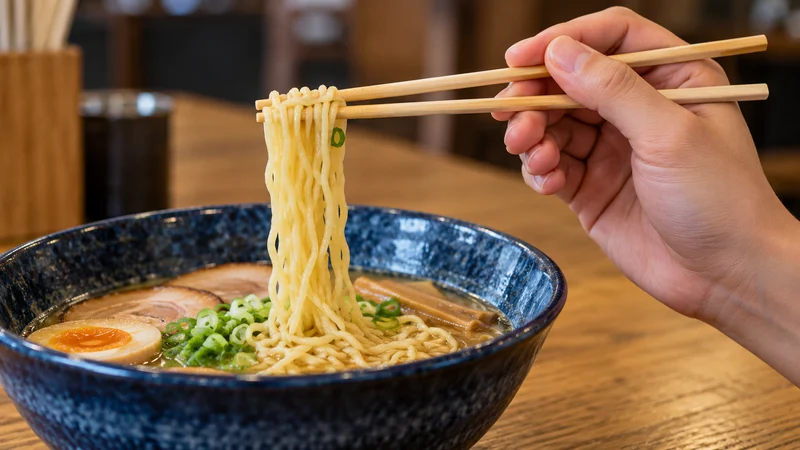
Let a spoon carry some of the load
When a soup spoon is available, you can guide a small portion onto its bowl with the chopsticks. Hold the spoon close to the ramen bowl while doing this, so loose strands have somewhere to fall. The spoon provides support; the chopsticks select and arrange the portion.
This is an optional way to make the meal easier, not a test of whether you are using chopsticks properly. You can also use the spoon for broth or a soft topping that is awkward to grasp. Do not try to catch a large bundle halfway to your mouth; lower it and start with less instead.
For home practice, make one change at a time. First reduce the portion. Then check that the tips meet. If the task still feels uncomfortable, use the available spoon or ask for another utensil. There is no need to turn lunch into an endurance exercise.
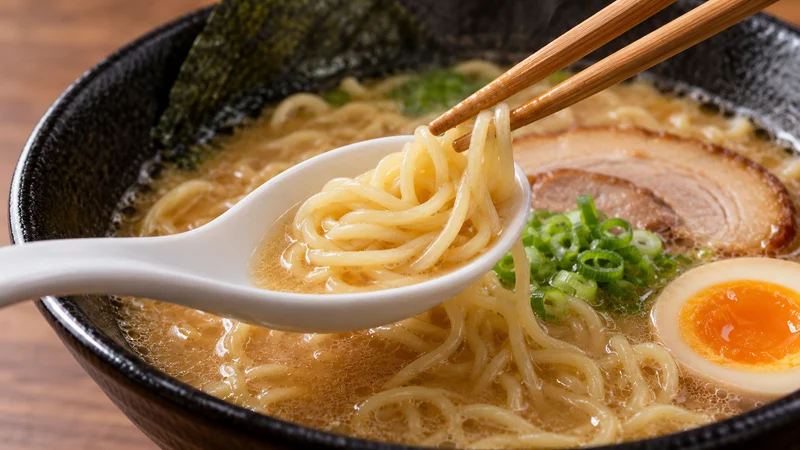
Slurping is an option, not an obligation
JNTO's Japanese food-etiquette guide explicitly permits slurping noodles. That cultural point does not mean you must make a loud sound, eat quickly, or copy someone else's pace. It also does not make hot broth cool enough to eat.
Focus on a portion you can manage rather than on producing the right sound. If strands keep escaping the tips, return to the grip and portion size. Making more noise does not correct crossed sticks or an oversized bundle.
Avoid treating every table practice as interchangeable. Follow the restaurant's arrangement and any guidance from your host. The aim of this guide is to help with ramen handling, not to turn one eating style into a rule for all noodle dishes or all Asian meals.
Pause with the pair on a rest
Between bites, put the chopsticks on the provided rest or a suitable clean side plate. Keep them away from the bowl's edge if they are likely to roll. Leaving the tips supported also makes it easier to pick up the pair again without fishing them out of soup.
The chopstick rest guide explains stable placement. You do not need an elaborate accessory: what matters here is that the pair stays where you put it and does not crowd the hot bowl.
End practice when the grip becomes painful or frustrating. The next useful attempt may simply be a smaller portion with the sticks reset in your hand. A comfortable meal is a better outcome than an impressive-looking lift.
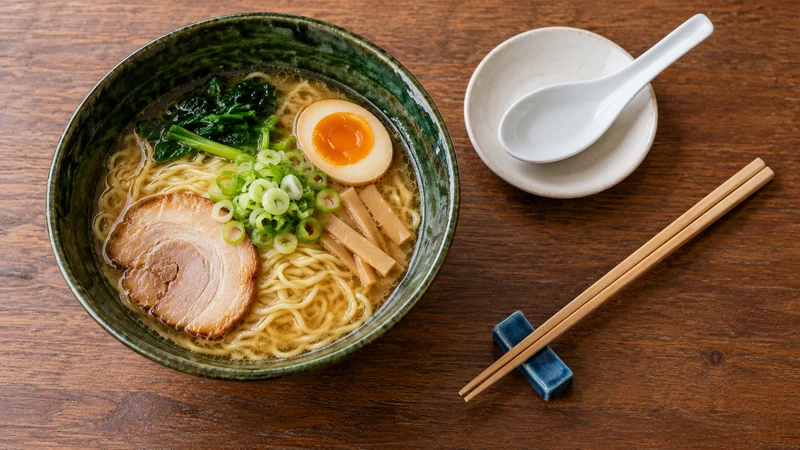
Quick Reference: what to change when ramen slips
| What happens | Try next |
|---|---|
| Tips cross | Reset the grip and align the tips away from the soup |
| Too many noodles rise together | Lower them and select fewer strands |
| Portion is difficult to carry | Guide a small amount onto the soup spoon |
| Food is too hot | Pause; a picture or dining custom does not establish temperature |
| Pair rolls during a pause | Use a stable rest or clean side plate |
These are small adjustments for practice, not promises that a particular utensil or technique will suit everyone.
Ramen questions at the table
Should I twist ramen around chopsticks like spaghetti?
You do not need to. Select a small group of strands with aligned tips and lift enough to separate the portion. If it becomes a large tangle, lower it and try less.
Can I use the spoon as well as chopsticks?
Yes. When a soup spoon is available, it can support a small portion or carry broth and soft toppings. Using it is not a failure of chopstick technique.
Is slurping ramen rude in Japan?
JNTO's Japanese food-etiquette guide permits slurping noodles. It is an accepted habit, not a requirement to make noise or eat faster than is comfortable.
Why do the noodles keep falling?
Check whether the eating tips meet and whether you are lifting too much. Lower the noodles before resetting the grip or selecting a smaller portion.
Where can I put the chopsticks while drinking broth?
Use the supplied rest or a suitable clean side plate, keeping the pair stable rather than leaving it where it may roll into the hot bowl.
Grip and dining source
Source checked November 2, 2026. The photographs are original generated illustrations of the meal and utensil arrangement, not evidence of a tested restaurant service or a measured food temperature.