Chopsticks Guide
Korean Sujeo Meaning: A Spoon and Chopsticks at One Meal
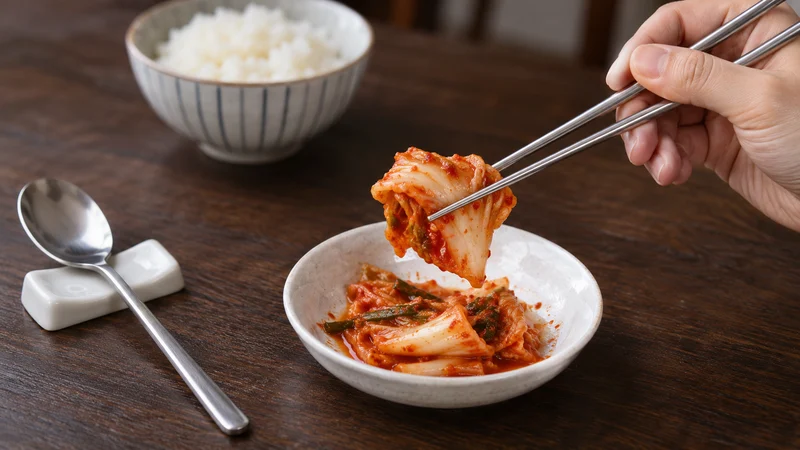
Quick Answer: Korean sujeo refers to the spoon and chopsticks used together as a dining set. The spoon is not merely a backup for someone who cannot use chopsticks: it has its own work with rice, soup and mixed food. At a Korean meal, understanding why both utensils are present is more useful than trying to eat everything with one of them.
The set is the starting point
A Korea.net article about Korean chopsticks describes sujeo as a spoon-and-chopsticks set. That particular article is by an Honorary Reporter, so it should be read as a cultural introduction rather than a technical standard for every product sold under the term.
For a guest, the useful distinction is between the set and an individual utensil. Seeing a long-handled spoon beside a metal pair is not an instruction to choose one for the whole meal. Nor does a matching design establish the metal composition, age or maker of the pieces. Those are separate product or object-identification questions.
Quick Facts
- Term meaning
- Spoon and chopsticks used as a dining set
- Spoon's role
- Rice, soup and mixing in the KTO introduction
- Setting context
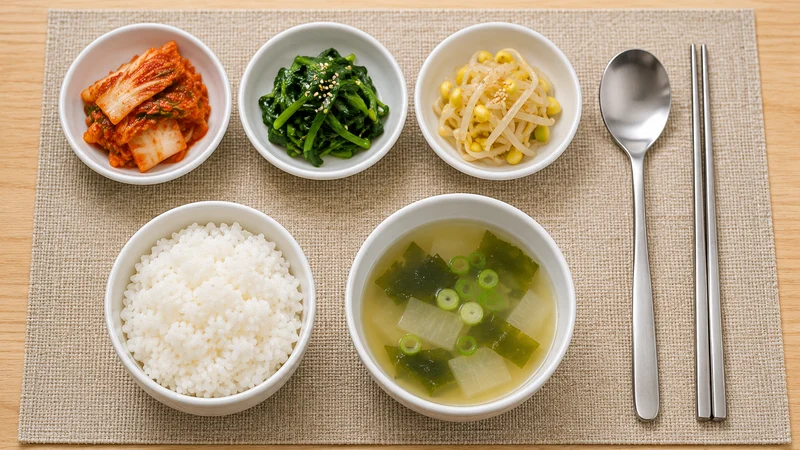
- Korea.net describes rice left, soup right and spoon left of chopsticks
- Evidence limit
- Cultural descriptions do not certify a product or every household's practice
Read the setting in its dining context
Korea.net's table-manners introduction describes rice on the left, soup on the right, and the spoon to the left of the chopsticks. It also explicitly acknowledges that many households eat casually. Treat the arrangement as a described convention, not a test that every host must pass.
Quick reference: what you are looking at
| Part of the setting | What it helps you understand |
|---|---|
| Rice bowl and soup bowl | Separate foods can call for different handling |
| Long-handled spoon | Rice, broth and mixed food do not need to be gripped between two tips |
| Chopsticks | Suitable pieces of food can be lifted individually |
| Rest or designated utensil position | There is somewhere to put one utensil while using the other |
The illustrations show one modern arrangement, not an exhaustive formal table layout or a photograph documenting a particular household. A restaurant may set out utensils differently or let diners collect them. Follow what is actually provided and ask if the arrangement is unclear.
The spoon changes how the meal works
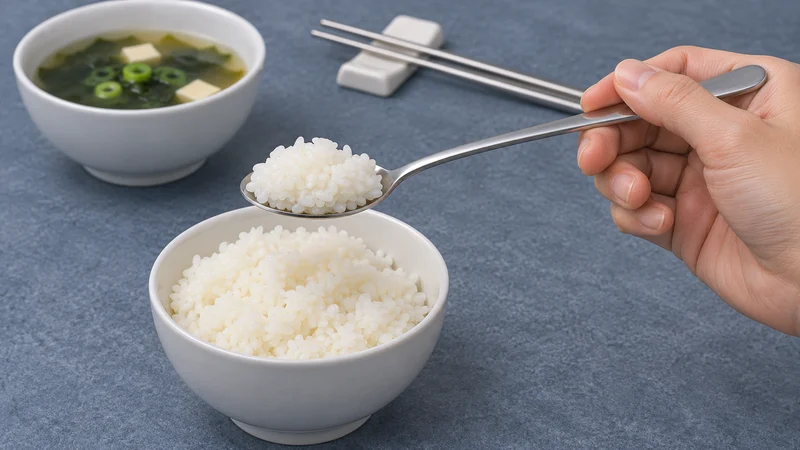
The Korea Tourism Organization's food introduction describes the spoon's central role with rice, soup and mixing. This is a more useful starting point than assuming chopsticks must do every task because they are visible on the table.
Consider a meal containing rice, broth and a firm piece of a side dish. The rice or broth may be more manageable on a spoon, while the piece of food can be controlled between chopstick tips. That is a practical example of complementary tools, not a rule assigning every Korean dish to a single utensil.
Choose a manageable mouthful rather than attempting a difficult lift to prove a point. The same source reassures visitors who find chopsticks difficult that the spoon is available. Needing another utensil does not require turning dinner into a dexterity exercise.
A coordinated set is not a materials certificate
Metal is prominent in the examples discussed by Korea.net, but appearance alone is not an alloy analysis. A silver-colored surface does not tell you that an item is solid silver, stainless steel or another metal. Equally, matching handles do not show that a purchased set has one cleaning instruction for all its parts.
If you are choosing a set, read its actual maker's material and care information. This article does not certify a product as dishwasher-safe, corrosion-proof, historically authentic or suitable for every food temperature. Its subject is the role of the two utensils at a meal, not a list of tested products.
Switch utensils without balancing everything at once
Put the utensil you are not using in a stable designated position before picking up the other. Keep its eating end clear of spilled food and avoid balancing loose utensils across a crowded shared dish. These are practical handling suggestions; the host's arrangement and your access needs still matter.
Korea.net's etiquette introduction describes keeping rice and soup bowls on the table. If that setup is difficult for you, ask for a comfortable adaptation rather than treating the convention as a reason to struggle with hot food.
For finger control, the site's Korean chopstick grip guide addresses a separate skill. Cooking utensils are another category again: the saibashi guide discusses Japanese cooking pairs, not a substitute for a Korean dining setting.
Does sujeo mean chopsticks alone?
In the usage described here, it refers to the spoon and chopsticks as a set. The two pieces have complementary roles at the meal.
Must I eat rice with chopsticks because they are provided?
No. The Korean tourism source specifically includes rice among the spoon's uses. Read the food and the actual dining situation rather than forcing every task through one utensil.
Does a matching metal set prove its material or age?
No. Check product documentation or an identified object's record. Matching appearance does not establish an alloy, historical date or safety certification.