 Chopsticks Guide
Saibashi: Choosing Japanese Cooking Chopsticks by Task
Quick Answer: Saibashi are Japanese cooking chopsticks: two separate sticks used to move, mix, turn, and serve food, rather than a hinged pair of tongs. Their extra reach can help at the stove, but a longer pair is not automatically easier to control. Start with the food and pan, then choose a length and tip shape you can manage.
A cooking tool, not an oversized table setting
MUJI calls its 30 cm bamboo cooking pair saibashi and describes uses including stirring and turning food. That gives a concrete example, not a minimum length for every product carrying the name. The same listing specifies a bamboo base with a urethane coating and says the product is not oven or microwave safe.
Those details matter more than the word “traditional.” Two visually similar pairs may have different coatings and care instructions. Nor does holding food at a distance remove the need to manage a hot pan safely.
Quick facts
| Feature | What to establish before use |
|---|---|
| Two independent sticks | Can you align and close both tips without excessive force? |
| Length | Can you reach the food without losing control of the tips? |
| Surface and coating | What cooking and washing conditions does this specific maker allow? |
| Intended task | Are you separating small pieces, stirring, or trying to lift something heavy? |
What the length comparison actually found
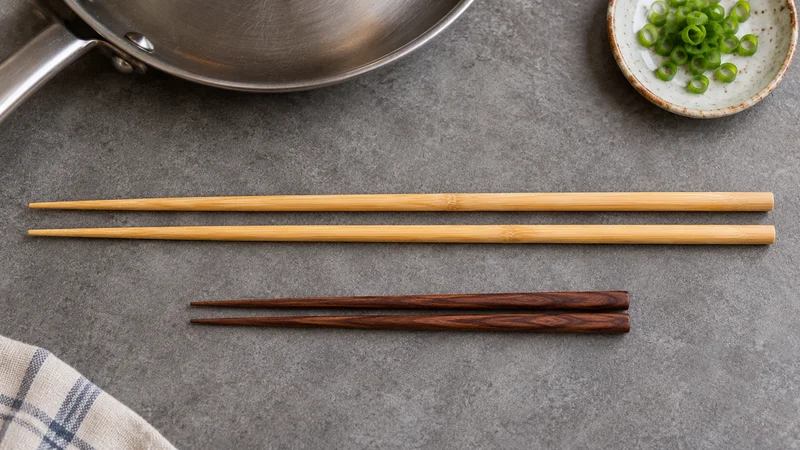
In a 1997 study by Kazuko Okuda and Kae Hayashi, researchers compared cooking chopsticks while preparing five dishes. The tested differences included 30 versus 33 cm length, tip treatments, connecting strings, and metal versus bamboo.
The longer tested pairs were preferred for frying and sautéing, whereas shorter pairs were easier for other tested tasks. Strings received lower ratings, while nonslip treatment received higher ratings across the reported assessment items. The authors' conclusion was task-based selection, not one best pair for every cook.
This was a particular comparison of particular utensils. It does not establish a safe temperature for all bamboo, prove every string is inconvenient, or identify a universal ideal length. The useful lesson is to test reach and control together rather than buying the longest pair available.
Choose around one meal you actually cook
Consider a meal with vegetables to turn, noodles to separate, and a large portion to lift. These are three different handling problems.
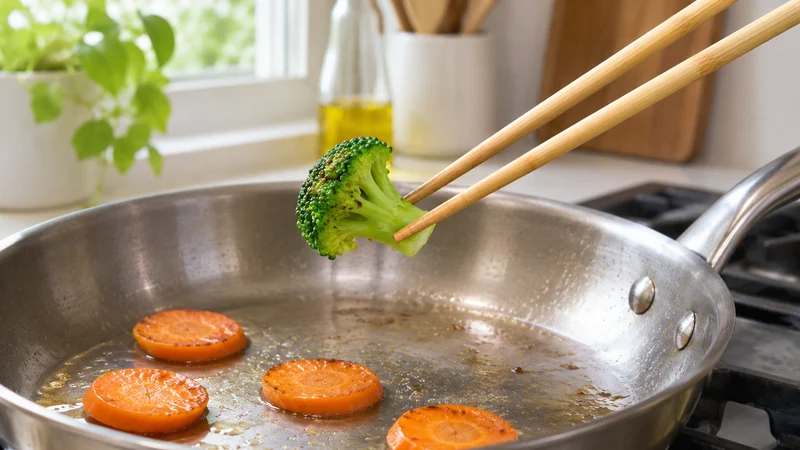
For the vegetables, a light grip may let you turn individual pieces without gathering everything into one bundle. For noodles, the goal may be separation rather than a tight squeeze. For a large or slippery portion, a different utensil may be the more controllable choice. These are practical selection prompts, not claims that saibashi can replace every spatula or tong.
Before introducing heat, try the pair with a small, cool practice item over a tray. Check whether the tips meet and whether you can release the item deliberately. If you must squeeze hard, repeatedly cross the tips, or reach uncomfortably, reconsider the pair or the task. There is no benefit in preserving a particular utensil choice at the expense of control.
A short stove-side routine
- Read the exact pair's material and use instructions. Do not infer oven, dishwasher, or heat suitability from the name alone.
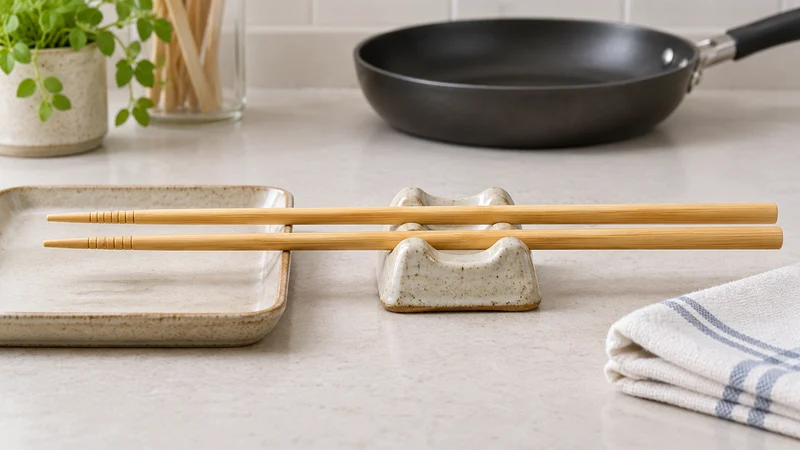
- Plan a place to put the utensil down without leaving it in the pan or against a heat source.
- Start with a manageable portion; use another tool when the load exceeds your comfortable control.
- Follow that product's cleaning instructions and inspect the tips before the next use.
This guide does not claim that its suggestions were independently tested with every food or stove. A maker's restrictions still apply even when a general cooking article recommends the utensil category.
Questions before buying a pair
Are saibashi the same as cooking tongs?
Not necessarily. Saibashi normally describes independent cooking sticks; a hinged tool closes differently. The Japanese wooden chopsticks guide distinguishes dining pairs from other intended uses; it is not a substitute for the cooking pair's instructions.
Must I choose metal for hot cooking?
No material name alone answers the question. Check the product's intended use, grip, and restrictions. The metal cooking chopsticks guide treats the material-specific choice separately.
Should I remove a connecting string?
Do not alter a product solely because one study rated its tested stringed pairs less favorably. Check the maker's design and instructions. A string is one feature to evaluate, not proof that a pair is either safe or unsuitable.