 Chopsticks Guide
Before Giving Meotobashi: Meaning and Recipient Checks
Quick Answer: Meotobashi, also written Meoto-bashi, refers to Japanese couple chopsticks: two complete eating pairs presented together as a gift for two people. Weddings and anniversaries are documented retail contexts, but the name does not impose one compulsory combination of colors, lengths or gender roles. Recognize the paired gift first, then check whether each recipient actually wants and can comfortably use the utensils.
The meaning starts with two complete pairs
A couple set normally gives each person their own two sticks. That means four chopsticks in the box, not two sticks to be split between the recipients. The relationship is expressed through the set's presentation; the utensils still function as two individual eating pairs.
The cultural reading also needs attribution. Kuroki Goishiten's Meoto-bashi listing connects the gift with a couple supporting one another and describes wedding and anniversary uses. This is a seller's explanation of a named gift, not evidence that owning it improves a marriage or that every Japanese household follows the same practice.
For a gift message, a simple wish for shared meals is enough. There is no need to promise luck, fertility, longevity or a particular relationship outcome. Let the recipients supply the personal meaning rather than writing their future into the object.
Quick Facts
- Gift meaning
- Two complete eating pairs for two people
- Context
- Couple gift; wedding or anniversary examples
- Design variation
- Unequal or equal lengths and colors
- Decision basis
- Recipient preference and actual product specification
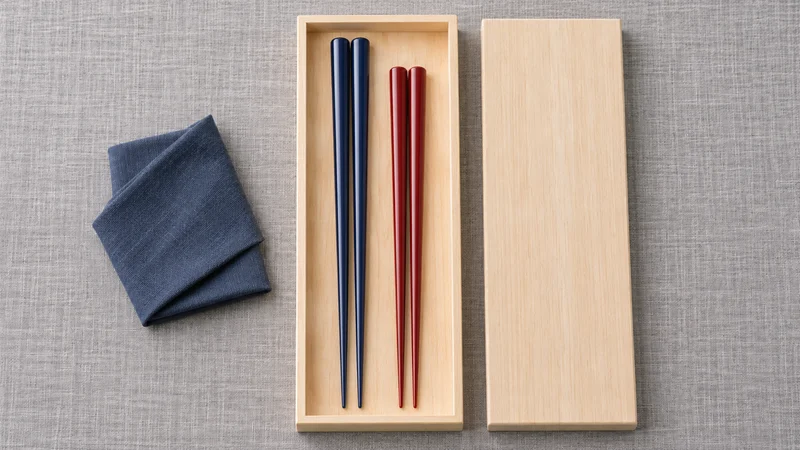
A named Meoto-bashi example shows one design, not a rule
The Kuroki example is described as Tsugaru-nuri with a Nanako-nuri finish, in indigo blue and madder red. Its specification gives approximately 235 mm for the blue pair and 205 mm for the red pair, with a paulownia presentation box. Those measurements identify that listing; they are not a standard definition of meotobashi.
This is a useful distinction when a shop shows two different lengths. You can describe the listed difference without deciding in advance which partner must take which color. Nor does a similar speckled finish establish the same craft process. The named maker or retailer should document the particular item.
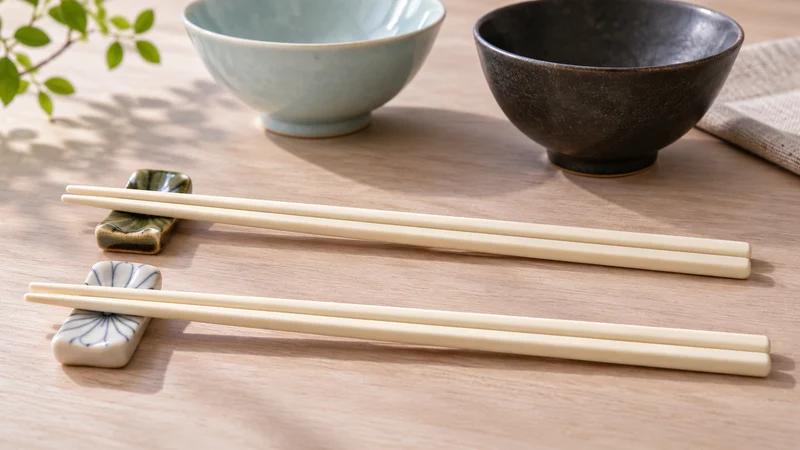
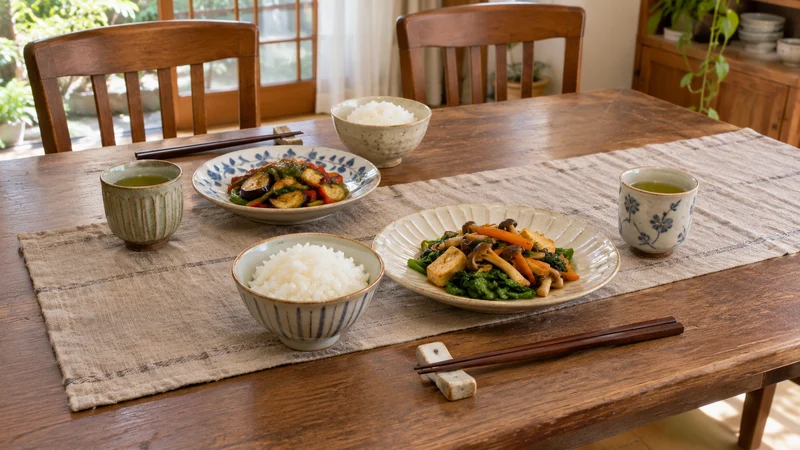
All three illustrations here are generated, unbranded examples. They are not photographs of the Kuroki or Matsukan products and do not verify a lacquer technique, measured length or manufacturing origin.
Equal-size Fuufu chopsticks make a different design choice
Matsukan's Fuufu project explicitly offers two pairs with the same color, length and thickness. The brand states a length of 22.5 cm and describes a white finish. The project's explanation also sets out its intention to move away from conventional red/black and long/short gender coding in couple gifts.
That documented alternative matters more than an abstract instruction to follow tradition. Equal pairs can still be a couple gift. Different pairs can also make practical sense when two people prefer different handles or lengths. Neither option requires assigning a utensil on the basis of gender.
The maker's inclusive design language should not be read as an independently tested claim that one size fits every hand. If possible, compare with chopsticks the recipients already enjoy using. If the gift is a surprise, ask a practical question about preferences instead of inferring them from height or appearance.
Quick Reference: what a paired gift does not establish
Swipe or scroll horizontally to see all columns.
| Visible or advertised feature | What can reasonably be said | What still needs checking |
|---|---|---|
| Two matching eating pairs | The utensils are presented as a coordinated set | Whether both users like the fit |
| Different colors or lengths | This particular design distinguishes the pairs | Who prefers each pair; no automatic assignment |
| A wooden gift box | The package is intended for presentation | Base material, coating and care of the chopsticks |
| A named regional finish | The listing makes a specific craft claim | Evidence connecting the actual item to that craft |
For construction rather than gifting symbolism, the Japanese wooden chopsticks guide separates the base, surface finish, tip shape and intended task. A country-style label alone does not answer all four questions.
Choose for the two people who will use them
Begin with the meal, not the box. Will both people use chopsticks regularly? Do they want a keepsake, everyday utensils, or both? A beautiful set that nobody can comfortably hold may be better kept as a display object than introduced as an obligatory daily tool.
Then check each complete pair on its own terms: the stated length, handle profile, finish disclosure and care instructions. Do not transfer dishwasher instructions from one brand to another, or assume that equal colors mean equal coatings. The lacquered chopsticks guide explains why gloss and the word lacquer are not complete material specifications.
Finally, make the presentation personal without turning it into a test of cultural correctness. An accompanying note can explain that the two pairs are intended for meals together. It can also leave either recipient free to choose a different everyday utensil. The shared gesture should not override individual comfort.
Questions before presenting the set
Does meotobashi mean sharing a single pair of chopsticks?
No. The couple-gift format discussed here contains two complete eating pairs, so each person has two sticks. The paired presentation is the connection between them.
Must the longer pair go to a man?
No fixed allocation is established by these examples. Ask which pair each person prefers rather than treating color or length as a compulsory gender rule.
Can both pairs have the same color and length?
Yes. Matsukan's Fuufu design is a documented example of equal-color, equal-length couple chopsticks. It does not prove that the same dimensions suit every individual user.
Does a presentation box prove traditional lacquerwork?
No. A box describes packaging, not the coating or craft provenance of its contents. Check the actual product specification and the maker's care directions.
Source notes
- Kuroki Goishiten: named Meoto-bashi set, retailer description and dimensions of one example.
- Matsukan: Fuufu project, the maker's stated design choices.
Source pages checked November 20, 2026. No price, availability, purchase promise or personal product test is implied.