 Chopsticks Guide
Lacquered Chopsticks: Finish, Care, and Buying Checks
Lacquer can describe a traditional urushi craft, a decorative surface, or a loosely labeled modern coating. A useful buying decision therefore begins with the base material and finish disclosure, not with shine alone.
Quick Answer: Lacquered chopsticks are chopsticks with a cured surface coating over a base such as wood. Traditional Japanese urushi is one specific lacquer tradition, but a product described only as lacquered may use another coating. Check the stated base, finish, food-contact instructions, care directions, and surface condition before choosing or continuing to use a pair.
Quick facts about lacquered chopsticks
- Base material
- Often wood, but the product label should say
- Traditional finish
- Urushi is lacquer made from tree sap
- Generic label
- Lacquered does not identify one coating by itself
- Care
- Follow the instructions for the exact product
- Condition check
- Look for lifting, cracks, rough edges, or exposed base
The word lacquered describes a surface treatment, not a complete material specification. Do not infer food-contact suitability, dishwasher use, allergen status, or craft origin from color or gloss.
Start with the base and the named finish
A lacquered pair has at least two material questions: what forms the chopstick body, and what coats it. Wood is common, but a retail description should still name the base. The coating may be traditional urushi, another lacquer system, or a modern finish described with broad marketing language.
Japan's Cabinet Office publication on Japanese lacquer explains that urushi is made from lacquer-tree sap and has long been used on wooden objects including bowls and chopsticks. That source supports the traditional material context; it does not prove that every glossy pair sold today is urushi-coated.
Treat an unqualified word such as lacquer, painted, premium, or Japanese-style as incomplete. Look for a specific finish name, the base material, maker or importer, country of manufacture, and instructions for food use. If those details are absent, describe the pair only by what is documented.
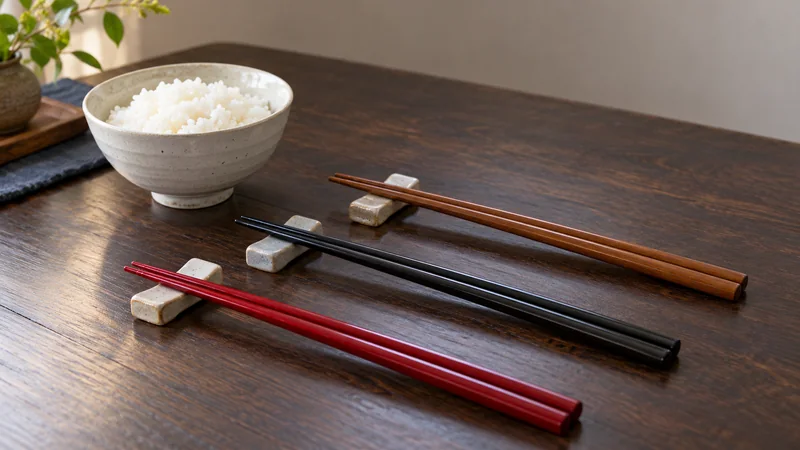
Traditional craft names identify particular processes
Traditional lacquerware is not a single visual formula. The official Joboji-nuri account describes repeated coating, drying, and polishing of a wooden base. It also presents durability and changing sheen as features of that named craft.
Wakasa-nuri uses another documented sequence. A Japanese government feature on Wakasa lacquered chopsticks follows undercoats, polishing, pattern materials, further lacquer layers, drying, and polishing. The article concerns a specific regional technique, not all lacquered chopsticks.
A craft name is useful only when the seller can connect the item to that process or place. A red, black, gold, or shell-like pattern may resemble traditional work without establishing provenance. Appearance can guide an inspection, but documentation supports an origin claim.
Inspect the surface before judging the decoration
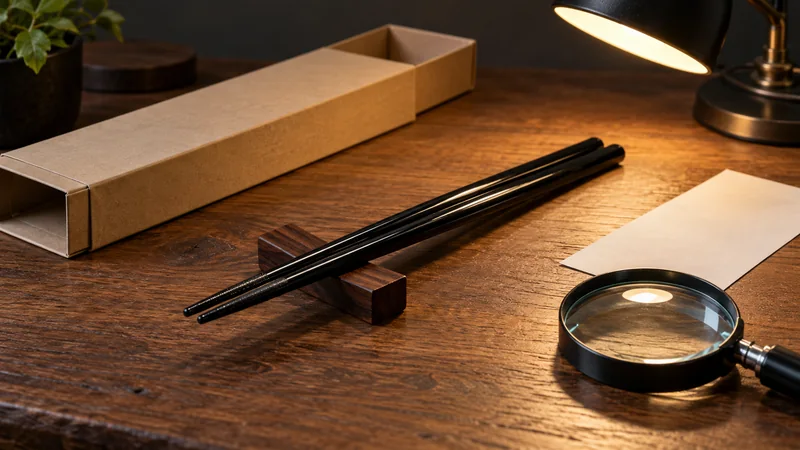
Rotate each chopstick under ordinary light. The surface should feel continuous where food and fingers contact it. Look for lifting flakes, deep cracks, rough chips, sticky areas, exposed base material, or damage around the tips. These observations do not identify the coating, but they help you notice a pair that needs the maker's advice or replacement.
Compare both sticks. Uneven color may be intentional handwork, while a sharp raised edge or a peeling patch is a condition issue. Decorative inlay and powder can be part of a documented technique, but loose particles are different from a stable finished pattern.
Do not use smell, flame, scraping, or solvents as home identification tests. Those actions can damage the finish and still fail to establish its composition. If material identity matters because of sensitivity, care requirements, or intended use, ask for product documentation instead.
Care instructions belong to the exact pair
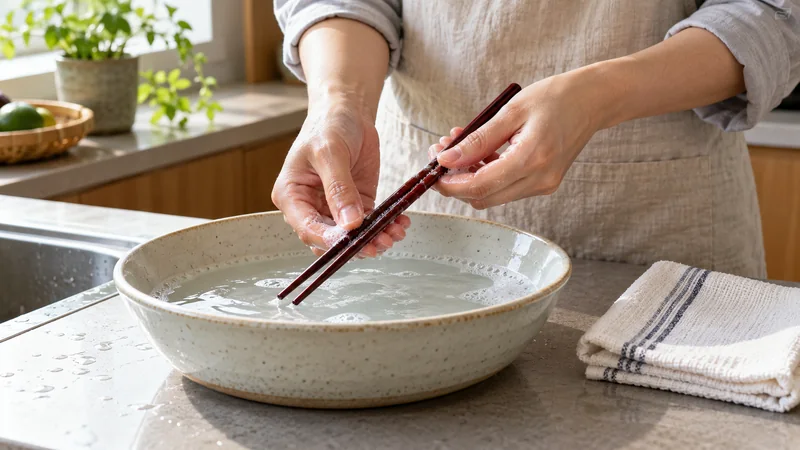
There is no safe universal washing rule for every product sold as lacquered. Heat, prolonged soaking, strong detergents, abrasive pads, and dishwashers may affect some finishes, while another manufacturer may specify a different routine. The product's care label should lead.
As one maker-specific example, Marunao's usage guidance tells owners how to wash and dry its wooden products and warns against certain appliances and conditions. Use that page for Marunao items, not as proof that every lacquered pair has identical limits.
For an undocumented pair, avoid inventing a care claim. Ask the seller or maker. If no instructions are available and the surface is deteriorating, retiring the pair from food use is a more cautious choice than repeatedly testing it.
Match the purchase record to the intended use
For daily use, prioritize a clear material statement, care directions, a comfortable length, and tips that suit the foods you eat. For a gift, add provenance and repair or replacement information. For a collectible, retain receipts, maker marks, packaging, and any craft certificate with the pair.
Price alone does not verify traditional manufacture. A high price may reflect decoration, branding, packaging, or small-batch work, but it does not replace a specific process description. Likewise, a low price does not reveal which coating was used.
Use the chopstick length guide to separate fit from finish, compare regional craft context in the Wakasa chopsticks guide, and review everyday wooden options in the Japanese wooden chopsticks guide.
Lacquered chopstick decision table
| What you can verify | What it supports | What it does not prove |
|---|---|---|
| Base and coating named | A documented material description | Craft origin or durability for every user |
| Named regional process | A specific craft claim to investigate | That a similar-looking pair uses that process |
| Maker care instructions | Care for that exact product line | A universal rule for all lacquerware |
| Smooth intact surface | No obvious visible damage at inspection | Hidden composition or future lifespan |
Keep the product label or receipt. It is more useful than trying to identify a coating later from color or gloss alone.
Questions about lacquered chopsticks
Are all lacquered chopsticks made with urushi?
No. Urushi is a specific traditional lacquer, while a generic lacquered label may refer to another coating. Check the product description.
Can lacquered chopsticks go in a dishwasher?
Do not assume so. Follow the instructions for the exact pair because heat, detergent, and drying conditions vary.
Does a glossy finish prove traditional Japanese craft?
No. A craft claim needs documentation connecting the item to a named process, maker, or place.
What visible damage should I check for?
Look for lifting, cracks, rough chips, sticky areas, loose decoration, or exposed base material, especially near the tips.
Are lacquered chopsticks better than plain wood?
Not universally. Finish, grip, care, documentation, condition, and intended use matter more than a single material ranking.
Craft sources and related guides
- Highlighting Japan, May 2022: Beautiful and Durable Japanese Lacquer
- Highlighting Japan: Joboji Urushi Lacquer and Joboji-nuri
- Highlighting Japan, November 2016, pp. 28–29: The Ultimate Chopsticks
- Marunao: product usage and care
The government craft sources describe named Japanese lacquer traditions. The maker care page is an example for that maker's products, not a universal standard.