 Chopsticks Guide
Rikyubashi Guide: Double-Ended Chopsticks and Tea-Meal Context
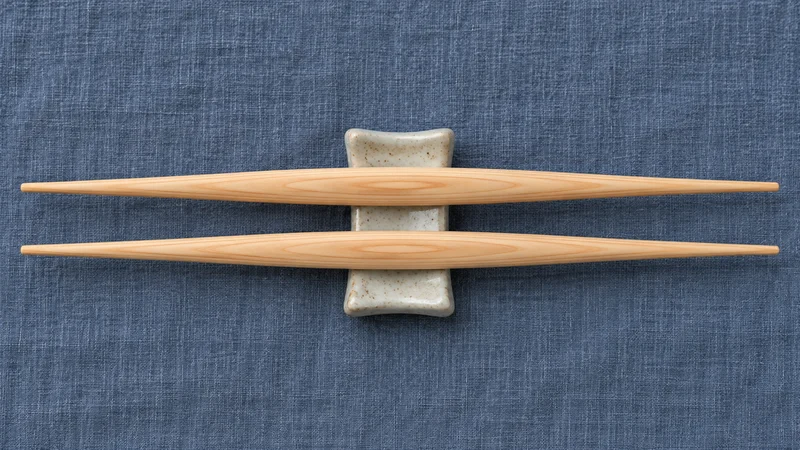
Quick Answer: Rikyubashi, also written Rikyu-bashi, are Japanese chopsticks with a broad middle and narrow ends on both sides. The shape is associated with tea-meal hospitality, but the name alone does not identify the wood, finish, length, or whether a particular pair is reusable. Recognize the double taper first; then read the actual product instructions or follow the host's guidance.
Look at the middle, not just the eating tip
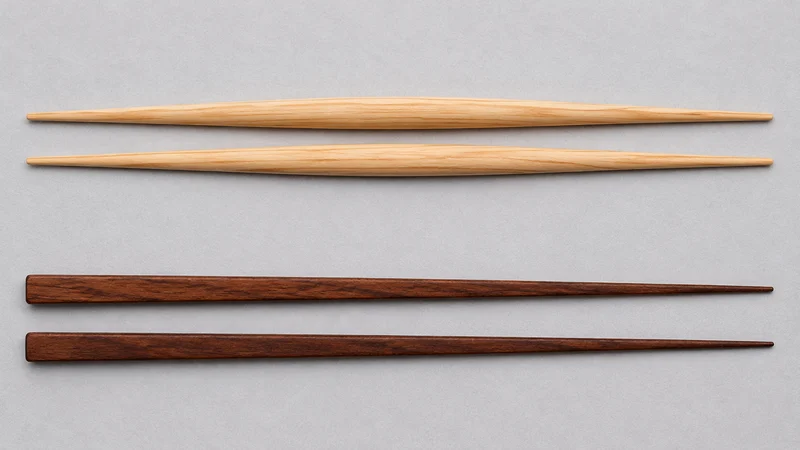
Ordinary eating chopsticks often narrow from a substantial handle toward one eating end. A Rikyu-style stick instead becomes wider around its middle and narrows again toward its other end. Looking only at the tip can therefore miss its defining feature. Set the complete pair against a plain background and inspect both ends and the center.
Japan's Ministry of Agriculture, Forestry and Fisheries describes this broad-center, narrow-both-ends form in its English WASHOKU booklet, printed pages 27-28. The same discussion places chopsticks in the different tasks of cooking, serving, and eating. A recognizable profile is useful vocabulary, not proof that every double-ended utensil has the same intended role.
Check the pair as supplied rather than forcing it to fit a name. Some products may arrive joined for splitting; others are two separate sticks. The presence of a split, a flat face, or a rounded section deserves its own description. None can be established by the English spelling alone.
Quick Facts
- Profile
- Broad middle, narrow ends on both sides
- Context
- Rikyu-associated tea-meal hospitality
- Materials
- Product-specific; cedar is not exclusive
- Care
- Follow declared finish and reuse instructions
Tea-meal association is not a universal handling script
The name connects the form to Sen no Rikyu and hospitality. A 1999 Forestry and Forest Products Research Institute article describes the Rikyu disposable form as based on the broad-middle, narrow-both-ends shape associated with the tea master's hospitality. That is an attributed historical account of a form; it is not a provenance certificate for a modern pair. It also does not establish that every item sold under the name was personally designed by him.
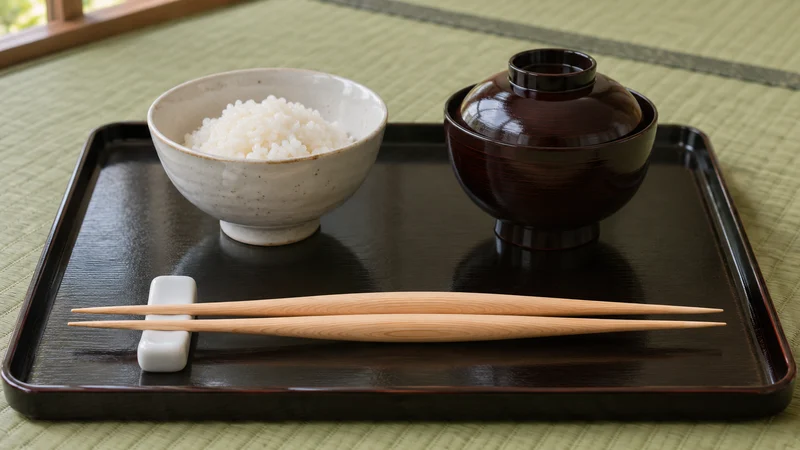
A contemporary illustration of a tray and bowls can show how such a pair might look at a meal. It cannot document a particular tea school's complete arrangement or etiquette. At a hosted event, ask how the supplied implements are meant to be used instead of inferring a serving procedure from their symmetry.
In particular, two thin ends do not automatically make it appropriate to reverse a used pair to take shared food. A distinct serving implement and the host's instructions answer a different question from the shape name. Keep those questions separate when describing or using the utensil.
One shape name can cover different materials and finishes
Nagai Shigyo's chopstick guide lists several materials under its Rikyu category, including cedar, hinoki, pine, bamboo, and aspen. Its account describes a thickened center, narrowed ends, and chamfering. This manufacturer evidence is enough to avoid saying that every item called rikyubashi must be cedar.
The same catalog distinguishes related commercial names such as ryohoso and ranchu. Overlapping silhouettes do not make every catalog term interchangeable. Preserve the maker's Japanese name in a note or inquiry, particularly when ordering replacements for a venue that needs a specific form.
Finish is another separate property. A pale appearance does not establish that a pair is uncoated, and a darker appearance does not establish a particular lacquer. Ask for the declared substrate and finish rather than identifying either from a photograph. If the instructions do not say whether the pair is single-use, do not treat the cultural name as permission to wash and reuse it.
Quick Reference
Swipe or scroll horizontally to see all columns.
| Detail to identify | What it can establish | What still needs confirmation |
|---|---|---|
| Broad center, two tapered ends | Rikyu-style profile | Exact maker's name and intended task |
| Joined or separate sticks | How the pair is supplied | Any splitting instructions |
| Declared wood or bamboo | Material for that product | Finish and care requirements |
| Maker's reuse instructions | Intended service life | Suitable cleaning and storage method |
For example, a cedar pair sold for one meal and a finished reusable pair may look similar at a distance. The outline does not settle their cleaning requirements. Keeping the original label or product page is more useful than relying on color, fragrance, or a seller's general use of the word traditional.
Match the pair to the task you actually need
If the purpose is ordinary dining, compare length, the supplied finish instructions, and whether the pair is comfortable for the user. The Japanese wooden chopsticks guide explains broader shape and finish choices. It is a companion to the Rikyu profile, not evidence that every Japanese wooden pair has two eating ends.
If the purpose is stirring a pot or cooking at a hot pan, consult the saibashi guide instead. Cooking length and task are not determined by a decorative or ceremonial association. Do not substitute a dining pair for a cooking tool merely because both are wooden.
Before a formal meal, the most useful question is specific: "Are these for my own food, and is there a separate serving pair?" Before buying, ask: "What is this model made from, what is its finish, and is it reusable?" These questions leave the cultural name intact while resolving the practical information it does not contain.
Questions about Rikyu-style chopsticks
What does rikyubashi describe?
It describes a Rikyu-associated chopstick form with a broad middle and narrow ends on both sides. The name alone does not specify every product property.
Are rikyubashi always made of cedar?
No. Cedar is an important example, but Nagai Shigyo's Rikyu category also lists other woods and bamboo. Check the particular product's declared material.
Are the two narrow ends permission to reverse a used pair?
No. The shape alone does not establish that handling practice. Follow the host's directions and use the designated serving implements for shared food.
Can every Rikyu-style pair be washed and reused?
No. Reuse and care depend on the actual product and its finish. Follow its instructions rather than assuming that a cultural shape name guarantees reuse.
Are these the same as long cooking chopsticks?
Not necessarily. Rikyu-style shape and a cooking utensil's intended task are different classifications; choose a cooking pair by its stated use.
Reading and product-description sources
- MAFF: WASHOKU, printed pages 27-28, the profile and utensil context.
- FFPRI: Wood in Daily Life, Part 7: Disposable Chopsticks, October 1999, the form's attributed connection to Rikyu's hospitality.
- Nagai Shigyo: chopstick types and Rikyu category, maker-specific materials and commercial naming.
Sources checked November 18, 2026. Images are newly generated illustrations of the described form, not verified product samples, measured comparisons, or historical artifacts.