 Chopsticks Guide
Why You Should Not Rub Chopsticks Together: Splinters and Etiquette
Rubbing a split wooden pair is often described as both a repair and a cultural signal. Those are separate claims, and neither should replace a direct look at the utensil in front of you.
Quick Answer: Usually, no. Split joined disposable chopsticks gently, inspect the tips and shafts, and ask for a replacement if a crack or raised sliver makes the pair unsafe or uncomfortable. Rubbing the sticks together is not a reliable repair, and it should not be described as a universal cultural offense because restaurant expectations vary.
The decision before the meal
- Habit
- Rubbing is not a required preparation step
- First action
- Split gently and inspect tips, inner split, and shafts
- Replace when
- A crack, raised sliver, dirt, dampness, or sharp edge is present
- Repair limit
- Rubbing or sanding cannot verify a damaged pair
- Etiquette boundary
- Do not turn one reaction into a universal national rule
- Restaurant response
- Set the pair aside and ask for another clean utensil
Why people rub disposable chopsticks
The familiar motion has a practical explanation: a diner has separated a joined wooden pair and wants to knock off loose fibers. That concern is understandable, but the rubbing itself does not tell you whether the pair is sound. It may miss a raised sliver, roughen an already usable surface, or scatter fibers near the meal.
Disposable chopsticks are not one uniform product. Japan's Ministry of Agriculture, Forestry and Fisheries describes several forms, including genroku-bashi and rikyu-bashi. The cut, wood, surface, and connection can therefore differ. A smooth pair needs no improvised finishing at the table; a visibly damaged pair deserves replacement rather than friction.
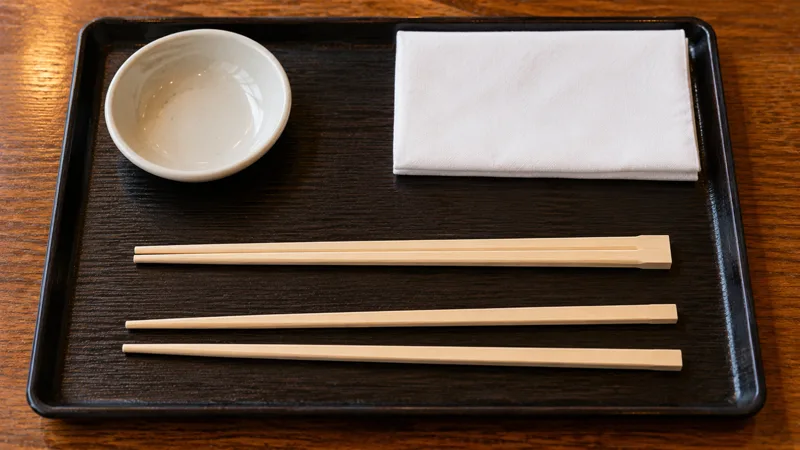
Inspect the pair before it touches food
Look at the eating tips first. They should be intact, reasonably even, and free of a sharp split. Then turn the shafts under available light. A faint grain line or harmless color variation is not the same as a projecting sliver that can catch skin. Run a finger only along a clearly safe area and away from the pointed eating end; do not test a suspected splinter by pressing it into your hand.
The FDA's model Food Code says single-service and single-use articles should be safe and clean. It does not prescribe rubbing disposable chopsticks as a consumer repair. That boundary matters: a diner can make a simple condition check, but cannot certify the wood, manufacturing process, or food-contact quality from appearance alone.
Ask for a new pair when a stick is cracked, sharply splintered, badly warped, dirty, damp before use, or separated in a way that leaves an unstable edge. Do not snap off a large sliver and assume the remaining surface is suitable.
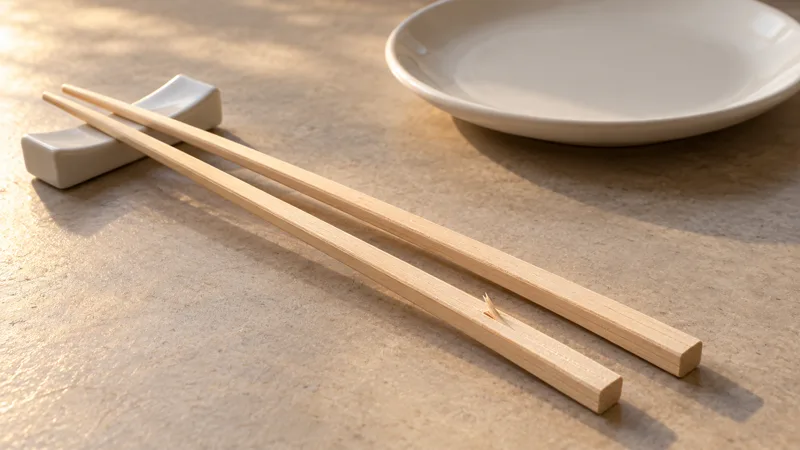
Open and check a joined pair in five steps
- Keep the joined pair above the tray or table and away from another person's plate.
- Hold the thicker upper ends, not the eating tips.
- Separate the pair with a slow, controlled motion rather than a dramatic sideways snap.
- Place both sticks down and inspect the tips, inner split, and outer shafts under the light.
- If the pair is smooth, use it. If it has a raised sliver, crack, or sharp edge, set it aside and request a replacement.
This routine solves the actual problem without turning rubbing into a ceremony. It also keeps your hands away from the food-contact tips. For basic grip after the check, see the site's how-to-use guidance.
What official etiquette sources do not establish
Some etiquette lists say rubbing disposable chopsticks signals that a restaurant supplied a cheap pair. That interpretation may occur, but it should not be presented as a rule shared by every Japanese diner, restaurant, region, or occasion.
The Japan National Tourism Organization's official food-etiquette guide identifies established concerns such as pointing with chopsticks, moving dishes with them, standing them vertically in rice, and passing food directly from one pair to another. A separate JNTO guide discusses opening wari-bashi. Neither source turns rubbing into a universal national rule. The evidence supports a modest recommendation: avoid a noisy sawing motion over the meal, inspect the pair quietly, and follow a host's or restaurant's cues.
That is why this page does not add rubbing to every country's rules. It answers one disposable-pair behavior.
Use the same decision in three dining settings
At a restaurant: Separate and inspect the pair without waving it over the table. If the wood is damaged, put it beside the wrapper and ask staff for another pair. You do not need to explain a cultural theory or repair the utensil yourself.
With takeout: Check the wrapper and pair before eating. If the package is open, wet, dirty, or the chopsticks are damaged, use another clean utensil. A disposable label does not make a compromised item acceptable.
At home: If you regularly dislike the feel or waste of split wooden pairs, keep a clean reusable pair that suits the food and your cleaning routine. Compare the tradeoffs in the disposable-versus-reusable guide rather than assuming every wooden pair performs the same way.
When pausing during the meal, use a stable rest or the placement provided by the restaurant. The chopstick rest guide covers that separate placement question.
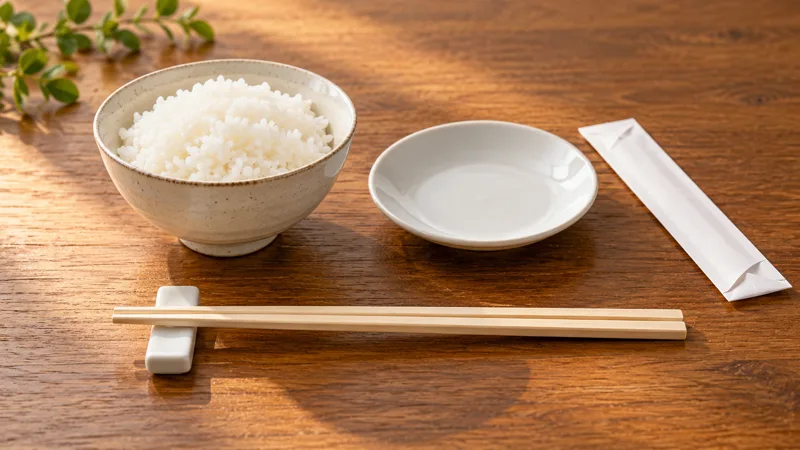
Quick Reference: what to do with a rough pair
| What you see | Best response | What not to assume |
|---|---|---|
| Smooth tips and shafts | Use the pair without rubbing | Rubbing is a required preparation step |
| A few loose fibers at the joined top | Keep them away from food and inspect the whole pair | The eating tips are automatically damaged |
| Raised sliver, sharp split, or crack | Request or choose another pair | Table-side scraping restores the original condition |
| Wet, dirty, or opened packaging | Use another clean utensil | Disposable means safe regardless of storage |
| Unsure about local manners | Handle the pair quietly and follow the host or staff | One online claim applies everywhere |
Questions about rubbing chopsticks
Why do people rub disposable chopsticks together?
Usually to remove fibers after splitting a joined wooden pair. The better first step is visual inspection; a damaged pair should be replaced rather than treated by rubbing.
Is rubbing chopsticks rude in Japan?
It can be viewed negatively in some settings, especially if the motion is conspicuous, but reliable official guides do not establish it as a universal rule for every restaurant or diner. Quiet inspection and following local cues is the safer answer.
What should I do if disposable chopsticks have a splinter?
Stop using that pair and ask for another clean pair or utensil. Do not press the sliver into your skin, snap off a large piece, or continue eating with a sharp surface.
Can I wash and reuse disposable chopsticks?
Do not wash and reuse a single-use pair as though it were designed for repeated cleaning. If the wrapper is open, the pair is dirty, or storage is questionable, choose another utensil.
Can I sand a rough disposable pair at the table?
That is not a reliable food-contact repair. Sanding or scraping can create more loose material and cannot establish that the remaining surface is suitable. Replacing the pair is simpler.
Sources for the condition and etiquette boundaries
The JNTO Japanese Food Etiquette guide and its chopstick handling guide bound the etiquette discussion. Japan's Ministry of Agriculture, Forestry and Fisheries describes multiple disposable forms in Characteristics of Washoku: Chopsticks and Bowls. The FDA 2022 Food Code supplies the single-service safety and cleanliness boundary.