 Chopsticks Guide
Wakasa Chopsticks: Origin, Lacquer Patterns, and Care
Quick Answer: Wakasa chopsticks are lacquered chopsticks associated with Wakasa-nuri, a regional craft centered in Obama, Fukui Prefecture. Their characteristic patterns come from layered lacquer and embedded materials that are later polished back into view. A glossy or patterned pair is not automatically Wakasa-made, so the maker, process description, coating, food-use statement, and care instructions matter more than appearance alone.
Wakasa chopsticks come from a regional lacquer craft
Fukui Prefecture's official travel guide describes Wakasa lacquered chopsticks as a craft made in Obama for over 400 years. It identifies repeated lacquer coatings and inlaid seashells, eggshells, pine leaves, and gold leaf as features of the craft.
That regional link is important. Wakasa-nuri is not just a color name or a generic label for Japanese chopsticks with glittering decoration. It refers to a craft tradition, a production area, and a recognizable family of layered lacquer techniques.
The craft is often associated with underwater imagery. Shell, mother-of-pearl, eggshell, plant materials, colored lacquer, and metal leaf can create irregular points and streaks that resemble a seabed after polishing. Because the pattern is built through physical layers, two handmade pieces need not look perfectly identical.
A finished pair may still use a modern variation, coating, or production method. Product descriptions should say what the chopstick body and surface coating are, who made or distributed the pair, and which care instructions apply. The regional story does not replace those product-level facts.
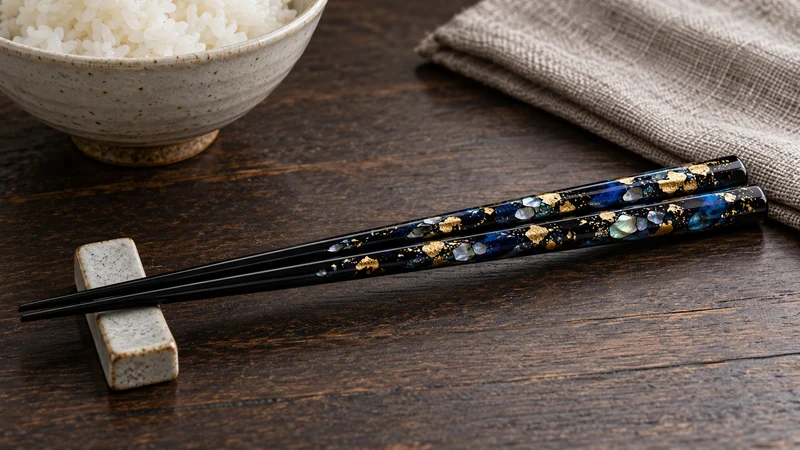
Wakasa craft and product facts
- Craft name
- Wakasa-nuri lacquerware
- Main area
- Obama, Fukui Prefecture
- Pattern materials
- May include shells, eggshell, plant materials, metal leaf, and colored lacquer
- Surface method
- Repeated lacquer layers followed by polishing
- Buying boundary
- Verify the maker, coating, food-use statement, and care instructions for the exact pair
Traditional Crafts Aoyama Square describes Wakasa Nuri as lacquerware from Obama. Its process uses materials such as shells, eggshell, pine needles, cypress leaves, rapeseed, colored lacquer, and gold leaf. Repeated coating, grinding, polishing, and final finishing bring the pattern to the surface.
This explains several visible features a buyer may encounter: depth beneath a glossy surface, irregular flecks rather than a flat printed repeat, and layered color that changes as the pair turns in the light. Those clues can be useful, but none proves origin by itself.
The safest identification evidence is documentary. Look for the maker or workshop, the place of production, the named lacquer technique, and a material or coating statement. If a seller uses only phrases such as “Wakasa style,” “Japanese pattern,” or “luxury lacquer look,” treat that wording as design language until stronger origin information appears.
Food-contact use also needs an explicit statement. A decorative vintage item, display piece, or unknown secondhand pair should not be assumed safe for eating because it resembles modern tableware. Cracks, peeling coating, exposed wood, sharp damage, or an unknown finish are reasons to pause rather than improvise a repair at home.
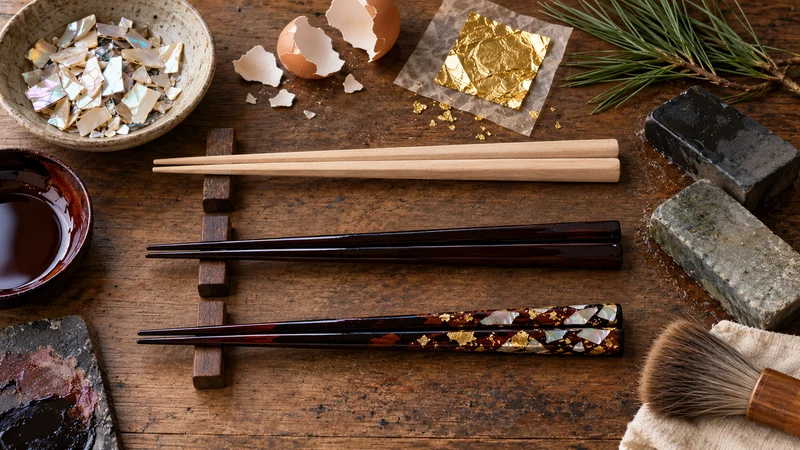
A decorative pattern is not proof of origin
Modern chopsticks can imitate shell flecks, gold dust, marbling, or deep lacquer color with printed films and synthetic coatings. That does not make those products defective; it simply means that appearance and craft origin are different questions.
Use a three-part check. First, read the origin claim: does the seller name Obama, Fukui, Wakasa-nuri, or a specific workshop? Second, read the material claim: does it identify the core and coating rather than saying only “lacquer style”? Third, compare the care label with the construction. A pair marketed as dishwasher-safe may use a modern coating and should not be described as though all traditional natural-lacquer care rules automatically apply.
Price is not conclusive evidence either. A high price can reflect packaging, brand, retail channel, decoration, or scarcity. A low price can indicate mass production, but it does not by itself prove a false origin claim. Documentation is more useful than an assumed price threshold.
For fit and daily use, also check length, weight, tip texture, straightness, and whether the two sticks feel balanced together. The chopstick length guide helps separate hand fit from decoration, while the Japanese wooden chopsticks guide provides a broader material comparison.
Quick Reference for inspecting a pair
| Check | What useful evidence looks like | What it cannot prove alone |
|---|---|---|
| Origin | Named maker, workshop, or Obama/Fukui production statement | A decorative Japanese motif |
| Technique | Wakasa-nuri process or layered lacquer description | A glossy surface |
| Materials | Core and coating identified for the exact pair | “Natural look” or “premium finish” |
| Food use | Clear tableware or food-contact use statement | Similarity to a modern pair |
| Care | Product-specific washing, drying, and storage directions | A universal rule for every lacquered chopstick |
Use the table as a verification sequence rather than a scoring system. A pair with incomplete documentation may still be attractive and usable, but the missing facts should remain missing rather than being filled with assumptions.
When shopping secondhand, ask for close photographs of the tips, handle ends, surface cracks, and any maker or packaging information. For an antique or collectible pair, preservation and provenance may matter more than everyday food use.
Care for the coating before the decoration
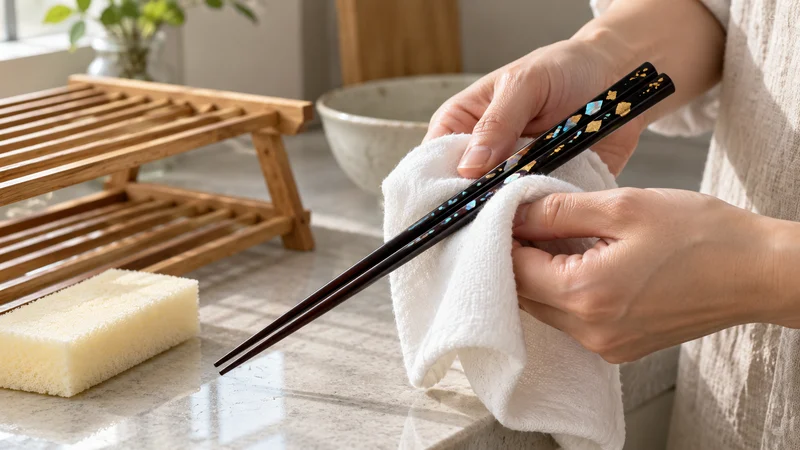
For natural lacquerware generally, Zohiko's lacquerware care guide recommends gentle washing with a soft cloth or sponge, lukewarm water or diluted neutral detergent, and drying with a soft cloth. It also warns against prolonged soaking, dishwashers, dryers, and strong light.
Apply those points only when they fit the exact pair. A modern Wakasa-style product may use a synthetic coating and may carry different instructions. Follow the maker's label when it is more specific. If the label says dishwasher-safe, that claim belongs to that product rather than to all Wakasa chopsticks.
For a pair that calls for hand washing, clean it soon after use, avoid abrasive scrubbers, wipe away moisture, and let it finish drying in open air before storage. Do not leave chopsticks standing in a wet cup or sealed in a damp travel case.
Stop using a pair if the coating peels, the tip splinters, a crack opens, or a repair introduces an unknown adhesive near food-contact areas. A workshop or seller is a better source for restoration advice than a generic home fix.
Questions about Wakasa chopsticks
What are Wakasa chopsticks?
They are lacquered chopsticks associated with Wakasa-nuri, a regional lacquer craft centered in Obama, Fukui Prefecture. The craft uses layered materials, lacquer, and polishing to create deep irregular patterns.
Are all patterned Japanese chopsticks Wakasa-nuri?
No. Printed, synthetic-coated, and other regional lacquered chopsticks can also be patterned. Check the maker, place of production, technique description, and product documentation.
What materials create Wakasa lacquer patterns?
Official craft descriptions list materials such as shells, eggshell, plant materials, colored lacquer, and metal leaf. The exact materials vary by item and technique.
Can Wakasa chopsticks go in a dishwasher?
Do not assume so. Traditional natural-lacquer care generally avoids dishwashers, but a modern product may have a different coating and a specific dishwasher-safe instruction. Follow the exact product label.
How should I store lacquered chopsticks?
Dry them completely, keep them away from prolonged strong sunlight and excessive heat, and store them where moisture cannot remain trapped. Follow any more specific maker instructions.
Wakasa chopsticks are best understood through both craft context and product evidence. The regional history explains the layered lacquer tradition; the label and maker information explain the exact pair in your hand.